Sex and its complements

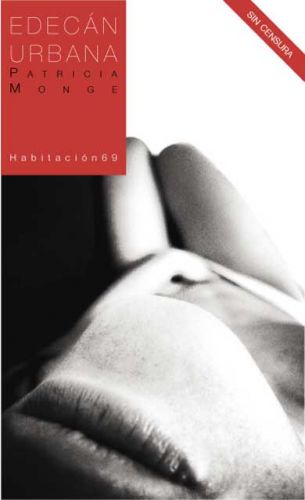
Balzac said that all great books are about sex and money. If he had read Patricia Monge’s book of short stories, Edecán urbana, he would have been satisfied at least halfway. If in the stories there isn’t a lot of money, this lack is compensated – as it is, if we are lucky, in real life – with an abundance of sex.

Monge’s book contains seven episodes in the life of a contemporary woman in Mexico City. The sex scenes are written without adornment, euphemisms, shame or shyness. Upon reading Edecán urbana, what is most striking is that there are so few authors in Mexico, male or female, who write about sex with such frankness. (Which perhaps should come as no surprise – according to one survey, 71 percent of women in Mexico say they are sexually unsatisfied.)
 

edecan

Forewarned is forearmed: Edecán urbana isn’t merely a dirty book. The author is also interested in those intersections in which sex isn’t only about sex – in Monge’s stories, sex is a camouflage for love, for falling out of love, for hoping to fall in love, for the desperate search for love, and the cynicism that accompanies the lack of love.

There are also substantial parts of the book that have nothing to do with sex, or in which the sex is indirect or imagined. Monge, an Argentine who has lived in Mexico for over a decade, like many foreigners, has an expertly jaundiced eye for social stereotypes, such as the petty bureaucrat. In my favorite parts of the book the narrator speculates about the conjugal life of one of these specimens, and how he engenders his infidelities.
maja-chica

In the photo above, the author adjusts an accessory.
Muertitos

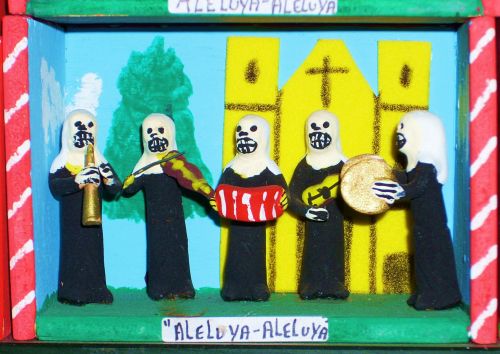
On the cusp of the Day of the Dead, it's a propitious moment to plug a store called Miniaturas Felguérez, located at Hamburgo 85 in the Zona Rosa. For decades they have sold miniature toys -- dolls, soldiers, and the like -- but their specialty has been these tiny boxes, a few inches wide, tall and deep, that depict calaveras (skeletons) in comic situations.

may-30-0272

They may be, as in this diorama, engaged in playing the Hallelujah Chorus.

may-30-028

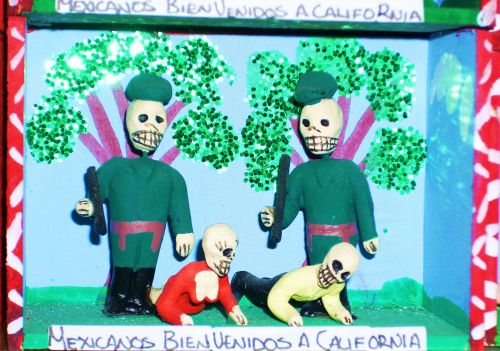
Or there may be an explicit political message, as in this one, which says, "Mexicans, welcome to California."

may-30-029

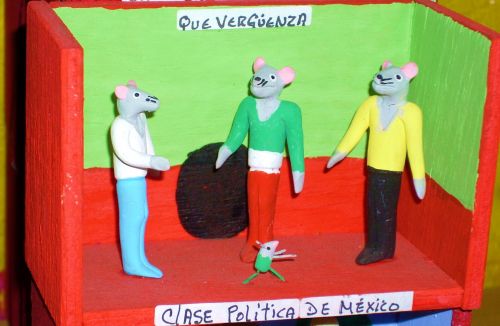
Or in this, which depicts Mexican politicians as rats (rata is synonymous with thief in Mexican slang).

may-30-068

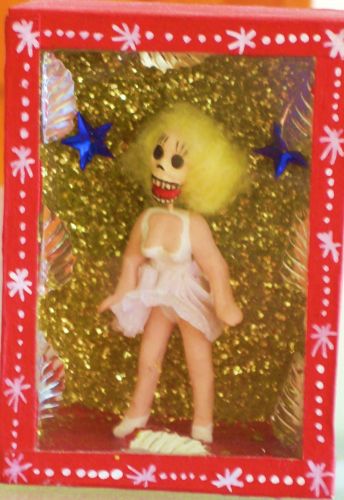
My favorite calavera here is a rendering of Marilyn Monroe. Actually I picked her up in Cuernavaca, but there is a whole host of celebrity skeletons at Felguérez.

Chucky y familia

Some notable boxers, mostly hard-luck flyweights from El Barrio de Tepito, have come out of Mexico City. Among them were the legendary Kid Azteca Villanueva, El Púas (Barbed Wire) Olivares, and El Ratón (The Mouse) Macías. If you go to Tepito today, there is still a boxing gym, where young men – and even women – who possess little more than hope spar with each other. Yet in the past few years there has been no regularly scheduled venue for what A.J. Liebling called “the sweet science.” You could only get tickets for the occasional amateur Golden Gloves bouts.


chucky-y-familia

Photo by John Stark

Until recently. For the past few months, at the Foro Scotiabank on Avenida Moliere in Polanco, every other Wednesday night there have been professional boxing matches. Ringside seats cost only 300 pesos, and there is waiter service with both food and drink. The other night, the most exciting fights were the four-rounders on the undercard. Perhaps because they had so little time to demonstrate their mettle, most of the fighters gave it their all.

The main event was supposed to be a ten-rounder with Osvaldo “Chucky” Razón pitted against Samuel “Torito” García. “El Chucky” was the favorite and, indeed, García -- who looked like one of the guys who collects garbage from the back of the truck that passes by my street each morning -- entered the ring with the expression of a man who has just swallowed a bad oyster. For the first three or four rounds, the fight appeared to be choreographed for a maximum of footwork and a minimum of damage, but then “El Chucky” seemed to remember why he was there and put a little pressure on García.

After seven rounds, “Torito” called it quits without even haven been knocked down. (They don’t make them like they used to. At least Roberto Durán was willing to take a lot of punishment before saying, "No más.") Pictured above are “El Chucky” and the most important members of his entourage.

Michael Parker guest blog

mugshot

Pictured in the mug shots above, Michael Parker moved to Mexico City a little over a year ago, by way of Virginia, Texas and New York. He lives in the centro histórico in an apartment that he shares with a cat and what is probably the world’s largest collection of muzak – some 1,500 albums, of which he has downloaded 28,700 songs onto his computer. Parker, who works principally as a translator, also writes the gossip column for the English-language monthly Inside Mexico, and has an encyclopedic knowledge of the centro’s cantinas (no mean feat for someone who arrived so recently). A little while ago he shared his observations about something he observed on the metro, and allowed me to reproduce them here:


So I was returning home on the subway this afternoon, minding my own business.


Then I see this spectre (filthy) get on the train with his six-year-old son (also filthy). Dad is shirtless, which I didn't really care for on the subway. Then he walks by and I see his back is rent with bleeding wounds and open sores, not unlike a Holy Week self-flagellate. I winced.


"Pardon my intrusion...," he began and then he unfurled a bundle of broken soft-drink bottle shards, like a cache of blood-besmirched jewels, which he spread across the subway car floor. Yes, we were in for a floor show.


I caught the eye of a teenage girl on the bench across the way and she looked at me imploringly, helplessly. We girt our loins for what we knew was coming.


The train all the while hurtling beneath the city, Mr. Dad stood on his hands during two or three seconds; then somersaulted down onto the glass with a lucha-libre-worthy thud. He lay there for a few seconds, then stood and allowed the boy to pull the glass out of his back. Junior gingerly returned the shards to their original quarry. I presume his delicacy was to avoid cutting himself. 


Apparently there's a market for this sort of gruesome entertainment--he collected from two patrons. 

Life as a lucha

dos-luchadores

Photo courtesy of El Museo de la Ciudad de México


Even if you are not a huge aficionado of wrestling, you will probably enjoy the exhibition which is in El Museo de la Ciudad de México on Calle Pino Suárez in the Centro Histórico until the 11th of January next year. It tells the 75-year history of the World Wrestling Council in Mexico, through photographs, movie clips, masks, magazine pages, interviews, signs, programs and so forth. There are also current artist’s renderings that highlight lucha libre iconography. My favorite part of the exhibition was finding out some of the names of Mexico’s most prominent wrestlers, such as The Communist from Pachuca, the Nazi Destroyer, Hurricane Ramírez and Cyclone Mackey.


 mascara


Meanwhile, I was walking down Calle Salvador the other day and spotted this fellow, apparently dressed for work (although what sort of employment he may have remains a mystery). I asked if he would let me take his picture, and he obliged, but preferred not to answer any questions.