Tons of fun

tell-mama

Photo by Everett McCourt

The other day a friend named Nuria Quella sent me an email pointing out that in Mexico City, 75 percent of women, 69 percent of men, and 35 percent of school-age children are overweight. Because of that, INMEGEN, the National Institute of Genome Medicine, is beginning a study among chilangos this November, trying to break down the obesity genome to see if it is possible to prevent obesity-related diseases, such as asthma, hypertension and diabetes.

Here’s my shocking confession, amigos. I don’t even know what a genome is. Believe me, I’ve tried to figure it out. I’ve read, I’ve done research. But the information goes in one ear and out the other.

However: Can we get real for a minute? I know some people will excoriate me for saying this. Chilangos are fat because they eat truckloads of junk food (both sweet and salty), are in a photo finish with the gringos for the highest per capita consumption of soda pop in the world, gorge on greasy tacos (however delicious they may be) and are loath to do any exercise. Wouldn’t a little behavior modification go a lot longer than genome research? I'm an ignoramus about science; I'm just asking.
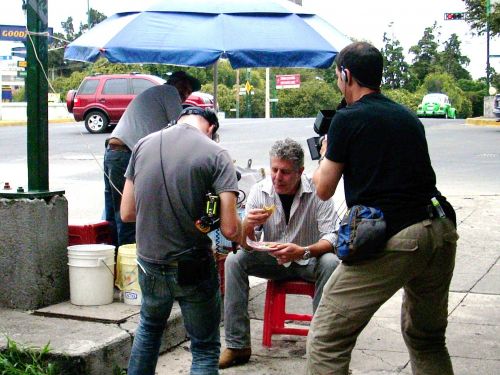
Anthony Bourdain in Mexico City

10-sept-009

A few weeks ago I got a call from a production company in New York. Called Zero Point Zero, they make Anthony Bourdain’s show No Reservations. They were wondering if I might be able to help them out while preparing to shoot a program in Mexico City.

They didn’t have to ask twice. I admire Bourdain and, having spent a couple of years of my youth working in restaurants, believe his book Kitchen Confidential is essential, one that had to be written. He is also one of the few people in the world I envy: Who wouldn’t like to be paid to travel around the world and eat?

In any case, I not only recommended some of my favorite restaurants, cantinas and stalls for eating street food, I was also able to spend some time with the crew while they were in town shooting. Bourdain – who everyone calls “Tony” – did not disappoint. Indeed, he fulfilled all expectations. The Lenny Bruce of cookery, he frequently spoke in uninterrupted monologues full of jokes of a scatological or sexual nature (sometimes both), jokes that would probably result in a lawsuit if I were to repeat them here.

The show is set to air early next year. Tony is pictured above sampling what is known as a taco sudado – a “sweaty taco,” so-called because after being fried in the morning they spend the next hours steaming in a basket until they sell out. They are the cheapest tacos in Mexico City and, in my opinion, sublime. There will be another post at a future date about Juan Monsalvo, the sweaty taco salesman under the umbrella.

Miguel Angel and San Charbel

june-6-016


A few years ago I read a review of a film called Game Six, and although it was not very favorable, I wanted to see it because its script was written by Don DeLillo, a writer I admire. I lamented that this was precisely the sort of small independent film that would never in my wildest dreams make it to Mexico City.

Six days later, I was having lunch in a cantina in the Colonia Narvarte called La Mansión de Oro. A man whose face indicated a great deal of life experience entered, and began to circulate from table to table. From a satchel, he was selling piles of pirated DVDs of recent films. Most were the usual suspects – the latest releases from Disney, action movies, blockbusters based on comic book characters. But there were also art movies from France and Japan, a smattering of black-and-white classics, and – lo and behold – Game Six.

After I made my purchases, the salesman, whose name is Miguel Ángel Zamora López, gave me a little card bearing the image of San Charbel, a Lebanese Maronite monk who was enshrined in 1977 by Pope John Paul II. He has become one of Mexico City’s most popular saints in recent years. (There are some 400,000 Mexicans of Lebanese descent, and they were the first to embrace Charbel and include him in their masses.) Miguel Ángel, pictured above, is one of the saint's truest believers.

After buying the film I invited Miguel Ángel have a drink with me. He told me he hadn’t touched alcohol in 17 years, so we made a date to have a coffee later that week. His dramatic story – and that of San Charbel – are in my book First Stop in the New World.

Tio Pepe

When my book Las llaves de la ciudad came out here, various interviewers asked me what my favorite cantina in Mexico City is. I think they were testing me, to see if I would come up with someplace they'd never been to, or a joint that's in every tourist guidebook.

tio-pepe1

Photo by Everett McCourt

Asking me which is my favorite cantina is a little bit like asking a mother which is her favorite child. Choosing a cantina has to do with various factors: what time of day it is, what neighborhood in which I find myself, whether I want to eat or am only interested in drinking. But if I absolutely had to choose one, I believe it would be Tio Pepe, at the corner of Independencia and Dolores, a stone's throw from the Alameda Central and at the portal of Mexico City's one-block-long Chinatown.

Shabby-genteel, the fixtures, and the stained-glass advertisement for Hennessy cognac above the bar, are from the turn of the 20th century. I like to go to Tio Pepe in the late afternoon, and sometimes stay until closing time, which is usually fairly early, around 10 pm. There is no food here, except peanuts. Most of the customers are older gentlemen getting progressively shitfaced. Sometimes itinerant troubadors wander in, guitar straps slung across their shoulders, but they are usually more interested in drinking than in performing.

sebastian1

Pictured above is Sebastian, who has been waiting tables at Tio Pepe for at least as long as I have been a customer (since 1990). Sometimes many months go by between my visits, but Sebastian always treats me --and whichever guests I may bring -- as if we show up every night and spend thousands of pesos.

Did you ever see an elephant fly?

dead-elephant

Some readers may remember the most memorable line from the film Dumbo. While we are on the subject of elephants, let’s have a moment of silence for Indra, 40 years old, five tons in her stocking feet, who broke free from her feeding at the Circo Unión in the wee hours last Monday night. The circus was in Ecatepec, near the Teotihuacán pyramids just outside of Mexico City, and poor Indra stumbled onto the traffic of the Mexico-Tulancingo highway, where she was hit by a bus. Witnesses say that the crash was inevitable – who expects to suddenly encounter an elephant while hurtling along the highway? The driver, Tomás López Durán, 49, also died a few minutes after the crash. But not until he managed to stop the bus in the mud beside the highway, thus saving all 41 passengers.