Loopy for Guadalupe

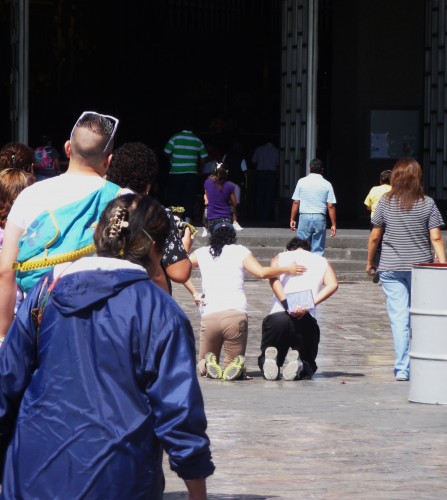
The Virgin of Guadalupe is not only Mexico's patron saint, but was declared "Patron of the Americas" by Pope John Paul II in 1999. On her feast day, December 12, she attracts about seven million worshipers from around the world at her shrine in the north of city. On any given day a few of the most devout make their way inside on their knees, like the couple above.

On a daily basis, there are between two and eight peregrinations to the Basílica de Guadalupe. In most cases special masses -- which cost between $120 and $400, depending on how many singers and organists are involved -- are given in the names of the pilgrims. On a recent month, the list of peregrinos included bicyclists from the town of San Isidro el Tanque, employees of the Le-Roy Laboratories, a group of podiatrists with the last name Hernández, and the inhabitants of the Cristantemo 13 Housing Project.
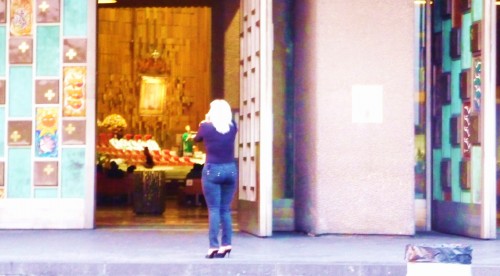
This believer had to take a cell phone call in the middle of Mass the other day. You got to hand it to her for wearing pants that tight to church

Of horticulture and Hyatt

Palma and Hyatt

The majestic palm tree on the left, known simply as "La Palma," is on Paseo de la Reforma. If you are standing in this direction, calle Rio Rhín in Colonia Cuauhtémoc is on the left, and calle Niza in the Zona Rosa on the right. Unfortunately, the stately tree -- planted in 1862 -- has been dwarfed by the skeleton of an ambitious project that was to be a combined hotel and condominium. Sometime after the economic crash of 2008, the Hyatt people seemed to have stopped work on the project. It has been more or less in this state for the past couple of years.

Do you have plans this coming Wednesday?

INVITACIONMUSEO-DE-LA-CIUDAD-DE-MXICO-1-250x500.jpg

If not, you might want to come to the Museo de la Ciudad de México (Calle Pino Suárez #30, Centro Histórico, near both the Zocalo and Pino Suárez metro stations) at 6:30 pm. First, they will screen Los ladrones viejos, an extraordinary documentary by Everardo González, which is more or less a Mexican version of Good Fellas, only it's all too real. Afterwards, González and I will present J.M. Servín's book D.F. confidencial, a tragicomic series of crónicas about some of the more desperate sides of Mexico City. For those who stick it out, mezcal will be served after the proceedings. That is this Wednesday, the 22nd, at 6:30 pm.

Garbo drank here, sort of

When it opened its doors in 1936, Ciro's, the nightclub on the top floor of the luxurious Hotel Reforma, became the most fashionable spot in Mexico City. Diego Rivera painted the murals on its walls. According to a book by Armando Jiménez, one night in 1944, management received a telephone call, putatively from the Swedish Embassy, that Greta Garbo was on her way, landing in Mexico City from an Acapulco holiday, and wished to remain incognito. "Garbo" -- in fact, a French model -- arrived with an entourage, rented the hotel's Presidential Suite, consumed various bottles of champagne and cognac, signed for them and disappeared without paying.

Tragedy as well as comedy occurred at the Reforma. Three years earlier, in 1941, W.J. Cash, a U.S. writer in Mexico City on a Guggenheim Fellowship, was found hanging from his necktie in the bathroom of his hotel suite. Although deemed a suicide, there is some controversy over whether or not his death was actually a murder. Cash was an active anti-Nazi -- he'd written dozens of newspaper editorials against them -- and at the time Mexico City was alleged to be a hotbed of Nazi spies.

The greatest tragedy is perhaps the demise of the hotel itself. Having been eclipsed by other luxury hotels along the Paseo de la Reforma, it has remained empty for decades.