
Would you mess with that she-wolf? How can her friends dare to ignore her? But then again, most mannequins with blue hair tend to be very involved with their cell phones. This photo was taken at the Liverpool department store.
Would you mess with that she-wolf? How can her friends dare to ignore her? But then again, most mannequins with blue hair tend to be very involved with their cell phones. This photo was taken at the Liverpool department store.

Opened in 1935, the Abelardo Rodríguez market is named after a nearly-forgotten man who served as president of Mexico for two years (and was really a puppet for Plutarco Elías Calles, a former president who remained the power behind the throne).
What little I know about Rodríguez sounds like the stuff of a novel. From the northern state of Sonora, he did not even finish primary school. He worked as a miner, in a hardware store, and as a baseball player before joining up with the Mexican Revolution. His most significant legacy was to lengthen the presidential term from four to six years, even though two were plenty for him.
The market, in the centro on the corner of calles Venezuela and Rodríguez Puebla, is one of the few left in Mexico City that was built before World War II. Some of its walls and ceilings are decorated with Socialist themed murals painted by various young artists who studied under Diego Rivera, including Antonio Pujol, Pablo O'Higgins, Marion Greenwood and Isamu Noguchi.
Noguchi had already established himself in New York and Paris before coming to Mexico, and while working with Rivera, would have a passionate affair with Rivera's wife, Frida Kahlo. His mural is on the upper floor of the market, which was closed at my last visit. Sadly, all the art work has decayed with the passage of the decades, but a process of restoration is in progress.
Postópolis D.F. began yesterday. Any of you out there who don't know what Postópolis D.F. is? Shame on you. Click here for details. I'm on Saturday's calendar. There will be an after-party.

This post encompasses my geographical axis of Mexico City, New York and New Orleans. Along with her partners, Nathalie Jordi, pictured above, began a business selling Mexican-style paletas -- frozen popsicles -- at the gourmet Chelsea Market in New York. They are the perfect antidote to the stifling humid weather that plagues New York in the summer. However, unlike Mexico, where they cost less than a dollar a piece, Nathalie's cost $3.50. (She uses only natural, locally grown fruits, organic cream and other high-end products. And let's not forget that Chelsea is the home of some of the most frighteningly expensive real estate in the world, including the market where she rents.) If you want to find out more about her paleta business, click here. If you want to sample her paletas, try to get there before August 15. Nathalie was accepted for the MBA program at Tulane University in New Orleans, the city where her heart is. Who knows who'll be selling them after that?

When I first came to Mexico I drank a lot of tequila but somewhere along the line I lost my taste for it. About ten years ago there was a shortage of agave, the plant from which tequila is made. Some say that since then, tequila makers have used immature plants and speeded up the distilling process, so their product isn’t as flavorful as it used to be.
However, I learned to like mezcal. It is also made from agave, but rather than steamed, like tequila, it’s roasted in a pit in the earth, which gives it a smoky flavor. As one mezcal importer – I’ll get back to him in a minute – said to me, “What would you rather eat, a boiled potato or a roasted potato?”
The photo above is of a wonderful mezcal called Dioseño, so-called because it comes from a tiny town in the state of Durango called Nombre de Dios (God’s Name). I have actually been through that town and, apart from its mezcal, a more fitting name might be Godforsaken.
Dioseño, and other wonderful small-batch mezcals, are sold in Mexico City by a fellow named Cornelio Pérez. He has frequent tastings at bars and restaurants in the city. If you want to get on his mailing list, write to him at mezcalestiocorne@prodigy.net.mx. Feel free to mention my name.
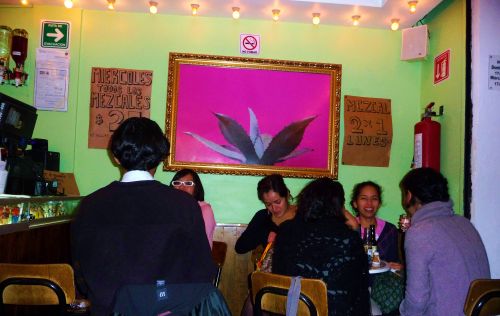
Mezcal became hip among youths in Mexico City a few years ago, when a bar specializing in that drink called La Botica opened. There are now several branches of La Botica around town, and even one in Madrid. Click here to go to its web site.

But if you become a mezcal convert, this guy is your daddy. For the past fifteen years, Ron Cooper has been going to remote villages in Oaxaca, where the best mezcal is produced, and importing it to various countries, including the U.S. (He is the one who made the potato analogy.) His stuff is expensive but absolutely incredible -- as fine as any whiskey or cognac you can buy. Click here to find out more about it and where you can get it.