Art and theft

mx-and-no-001

The Colonia Buenos Aires, in central Mexico City, is full of chop shops where you can buy spare parts or get your car repaired at bargain prices. Auto theft is a common crime in the city, and many claim that the neighborhood's cut-rate rear-view mirrors,  windshields, radios and steering wheels come straight from stolen vehicles.

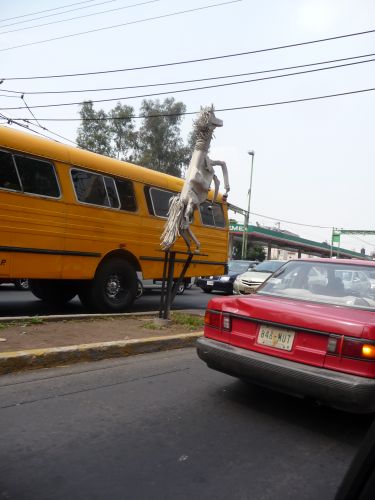
Don't lose heart, though: your purloined auto may have had a higher purpose. On the traffic island in the middle of Calle Dr. Vertiz, just north of the Viaducto, there is a series of sculptures made from auto parts. Of course no one wants to get their car ripped off, but show some sympathy: We all know how tough it is for struggling artists to acquire their materials.
Swill

P1020188

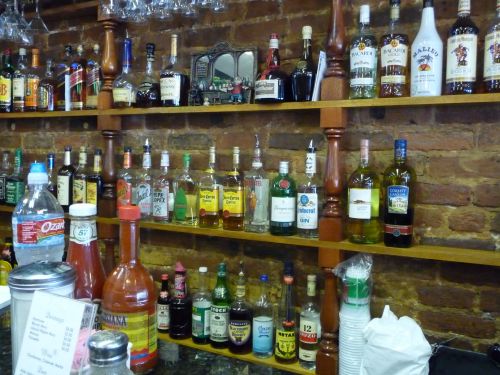
Once you leave Mexico, drinking tequila is a dodgy issue. Take a look at the bar at Mena's Palace, a beloved luncheonette in the French Quarter of New Orleans.  On the middle shelf you can find a couple of brands of tequila, "Juarez" and "Pepe Lopez," that I have never seen in Mexico. Call me skeptical, but I wouldn't disinfect my bathtub with that stuff. (I would also stay away from that bottle of  "Aristocrat" gin.) Something tells me that Mena's has Greek owners, because  on the bottom shelf they carry both Metaxa, a brandy I remember from my sojourn in Athens as a 20-year-old, and several brands of ouzo, including one that appears to be twelve years old.

Mujerona

diana

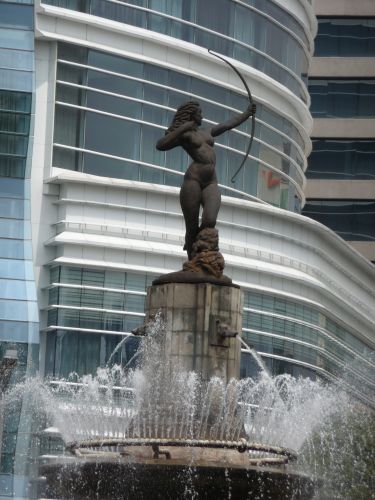
After the Angel of Independence, this statue of Diana, the Roman goddess of the hunt, is arguably the most well-known landmark in Mexico City. You can find her on Paseo de la Reforma, not far from Chapultepec Park.

A well-worn anecdote has it that in 1944, two years after the monument was unveiled, Soledad Orozco, wife of President Manual Avila Camacho, was so scandalized by the statue's voluptuous nudity that she demanded it be covered with a loincloth. The art world's disapproval of her position was eclipsed by the support she got from the National League of Decency and Archbishop Luis María Martínez. The sculptor, Juan Fernando Olaguibel, was forced to concede her wish.

In 1967, President Gustavo Díaz Ordaz decreed that the statue be returned to its original state. Olaguibel was obliged to start from scratch, as removing the loincloth would have caused too much damage to the first statue. The ceremony of its unveiling happened in the middle of the night, so as not to cause more scandal.

The identity of the model -- Helvia Martínez Verdayes -- wife of a one-time director of the state oil monopoly, PEMEX -- was not revealed until 1992.

Theatre

OLEANNA_PARABUS_rgb

Two or three years ago, a friend named Daniel Pastor told me that he wanted to translate David Mamet's Oleanna and produce it onstage in Mexico City.  Politely, I tried to discourage him, pointing out that the play had already been translated and produced here in the mid 1990s. I wondered out loud whether a twenty-year-old play that deals with sexual harassment would be understood in a country where sexual harassment is common, if not the norm.

Luckily, Daniel didn't give up. I went to the opening last Saturday and, to judge from the audience reaction, Oleanna is as relevant as ever -- perhaps more meaningful in Mexico today than it was fifteen years ago, as more people wake up to the concept of harassment.

It is a two-character play about a seemingly mousy and hapless university student who comes to a professor's office to implore him not to give her a failing grade. As John, the harried teacher, Juan Manuel Bernal's long-winded, pedantic speechifying is spot-on, but as Carol, his surprising pupil, Irene Azuela kicks ass.  When the power shifts in the second and third scenes of the play, she is frightening in her intransigence and vengefulness.

Oleanna is on a Thursday through Sunday schedule at Teatro El Granero, behind the Auditorio Nacional in Chapultepec Park. Sadly, most of my friends in Mexico City never go to the theatre. Don't even think about missing this.

Under the wire

martell

One of the curiosities of my neighborhood, the Colonia Nápoles, is that there are no cantinas. There are fine restaurants with white tablecloths, a couple of decent fondas and some great street food. But nothing even resembling a cantina.

martell-6

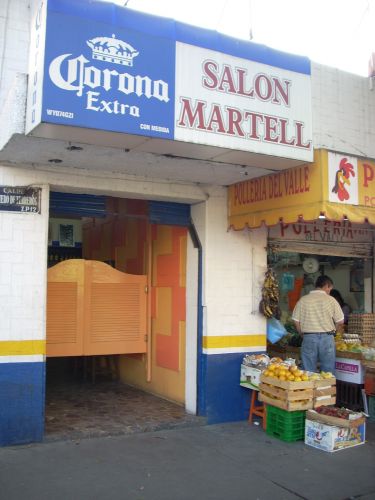
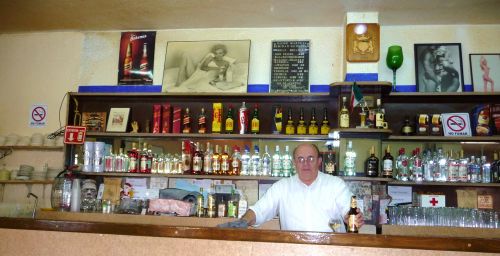
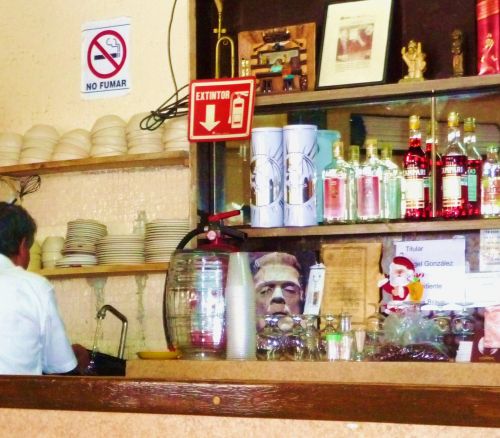
Not long after I moved there, Sergio González Rodríguez, a writer friend who knows the city's watering holes like the back of his hand, took me to a place called the Salon Martell. It is in the neighboring colonia, la Del Valle, on the corner of Mier y Pesado and Romero de Terreros. The bartender, todo un caballero, is named Tomás.

martell-7

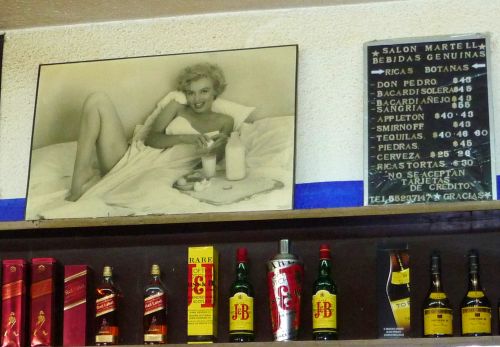
You got to love a cantina with a photograph of Marilyn Monroe above the bar. Particularly that photo.

martell-3

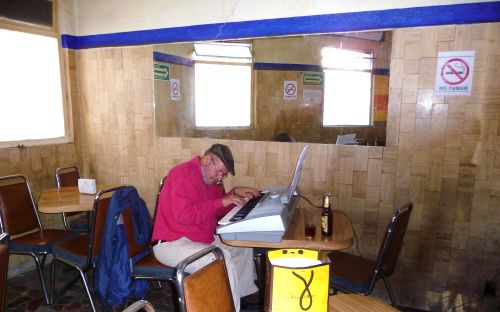
I am not sure why but the Salon Martell has few customers. (Then again, that is one of the reasons that I like it.) It also has one of those electronic jukeboxes with about a thousand songs. Sometimes on Fridays, the gentleman pictured above, known as "Eddie," plays U.S. oldies on an electric organ, and sings them with Spanish lyrics. The botanas -- free food served with the price of your drinks -- are also quite tasty at the Martell.

martell-2

Don't get spooked by the monster, who shares space behind the bar with Marilyn. And Santa.