Slice of building

bimbo

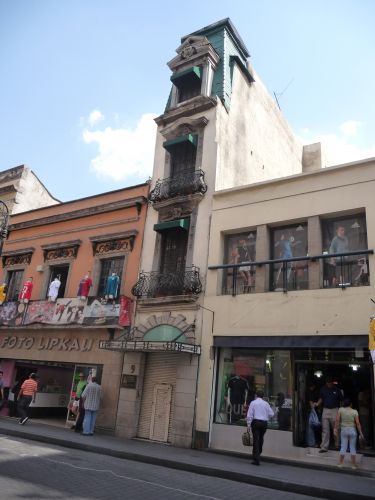
This building always reminded me a slice of Wonder Bread (or its Mexican equivalent, pan Bimbo). On Calle Venustiano Carranza in the centro histórico, for ages it was home to a seafood restaurant called El Malecón, but has been shut for the past couple of years. Sadly, I never went; it is hard to imagine how the waiters would have moved between tables in a space so narrow. Not long ago, I knocked on the door to see what, if anything, was going on. A porter told me that the property had been sold but had no idea to whom or to what purpose.

Party time

The New Orleans Saints go to the Super Bowl next Sunday. This is a first in the team's history, and for all we know, may be the last. But Mardi Gras comes every year, as attested by the Krewe de Vieux parade (one of the first of the season) a few nights ago. This particular parade is noted for political satire, this year directed at Mayor Ray Nagin, whose absence of leadership during and after Hurricane Katrina has been bitterly noted by nearly all citizens of the city. He will not be mayor much longer. Primary voting for the next election is scheduled for February 6, with a runoff, if necessary, set for early March. No one seems unhappy to see Nagin leave; indeed, he is cheerfully being referred to these days as "Na-gone."

Bottle

The float in this photo depicts Nagin with the legend "Such a Blight." This is a play on words of a song title of one of New Orleans' own Dr. John's greatest hits, "Such a Night." Note the bottle in the tuba player's pocket.

Krewe-de-Vieux-etc-009

This float shows Nagin in "City Hell" rather than City Hall. To judge by the beers in the revelers' hands, drinking is as much of a theme for the Krewe de Vieux as arch political commentary.

Rude

Some of the marchers had less subtle scorn to heap on Nagin (as well as Mitch Landrieu, his likely successor).

Kitties

A couple of cool kitties.


An empanada by any other name

charles

When there was silver to be mined in Mexico, many from the U.K. came to do the job. Some of them stayed. Among their imports -- at least to the state of Hidalgo, less than an hour from Mexico City -- were Cornish pasties, known here as pastes. Stuffed and baked, these savory pies are a specialty in Hidalgo's capital, the city of Pachuca.

However, if you are in Mexico City and hanker for a taste, you need not get on a bus to Hidalgo. On Calle Chiapas in the Colonia Roma, a few steps from Calle Medellín, there's a cafe called Pastes Real del Monte. Its owners are actually from that mining town, which is just outside of Pachuca, and their product is as good as anything you will find in Hidalgo (and better than most of it).

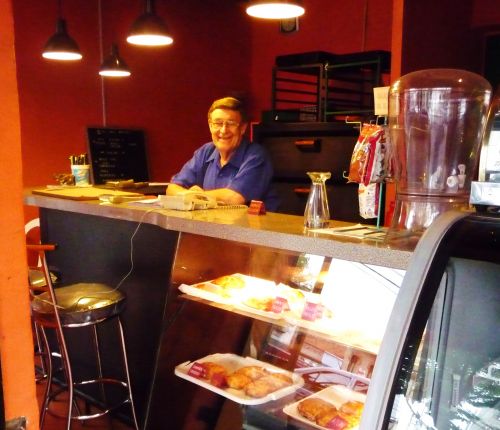
The proprietor, a Mexican who calls himself Charles (you can find him on duty late in the afternoons), is one of those old-fashioned types who wears both a belt and suspenders. He speaks better English than most native speakers. When I asked him why, he told me that as a child in Real del Monte, some of his teachers were from England.

Mexican Jewish history


MX-and-NO-0023

Yes, there are Jews in Mexico. Supposedly, the first arrived among the Spanish conquerors, men who sailed with Cortés to escape the Inquisition. Today, in Mexico City there are fewer than forty thousand, which makes them a tiny minority in a city of twenty million people (ninety percent of whom declare themselves Catholic).

They are often the object of fascination of Catholic Mexicans. They arrived in greatest numbers in the first decades of the 20th century, principally immigrants from Central Europe, Lebanon, Greece and Syria. They tended to show up penniless, and began selling things on the streets of the centro histórico, soon graduating to shopkeepers and small-business proprietors. Today, most are professionals.

For over a dozen years, Monica Unikel-Fasja (pictured above) has given guided tours of the Jewish history of the centro. She points out, enters, and tells the stories of the buildings that housed the synagogues, jewelry, clothing and textile stores, community centers and gymnasiums of Mexico's early 20th-century Jewish communities.

You can find out more about Monica's tours by visiting her website (www.jewishtours.com.mx) or by emailing her directly at guidtour@prodigy.net.mx.
Who says gringos don't like soccer?

Soccer

While looking for things for my apartment in New Orleans, I saw this charming conjunto for $199.99 at Royal Furniture at 2440 St. Claude Avenue. Could this be a testament to the growing popularity of soccer in the U.S.? Most of Royal's clients are black, but I wondered if this wasn't a special order for some of the tens of thousands of Mexicans who immigrated to New Orleans after Hurricane Katrina. They were largely responsible for the cleanup and reconstruction of the city.