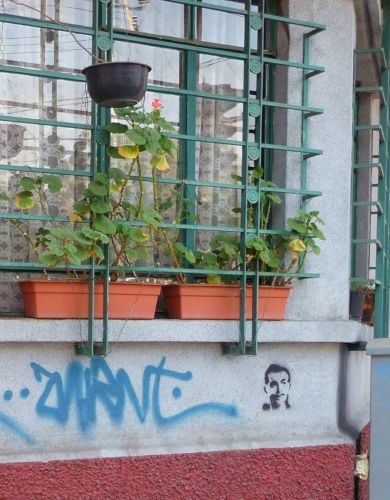
Immaculately dressed, every salt-and-pepper hair in place, sporting a Clark Gable moustache, Mauricio Garcés starred in a series of saucy comedies in the 60s and 70s, in the role of a mature and world-weary seducer, famous for lines of dialogue like "Debe ser horrible tenerme y después perderme" (It must be horrible to have me and then lose me) and "Dios sabe que tengo miles de razones por ser vanidoso" (God knows I have thousands of reasons to be vain). He died in 1989, but in the hearts of many lives on: Recently I saw this stencil of him on a wall in the Colonia Del Valle.
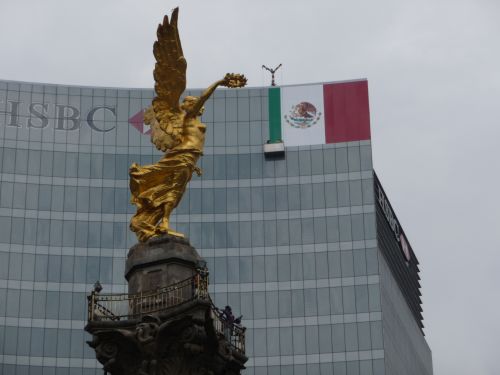
Our angel
Unlike many great metropolises, Mexico City, lacking much recognizable iconography, resists visual definition. The Angel of Independence, on Paseo de la Reforma, is its most famous landmark. Built in 1910 to celebrate the hundredth anniversary of the Independence, it is notably similar to the Victory Column in Berlin, which was built in 1866. The pillar is thirty-six meters high. The Winged Victory, which weighs seven tons, is of bronze and covered with twenty-four karat gold.
These days, in the evenings, the Angel is a popular spot for trysting young Mexico City lovers, and tourists stop by day and night to have their pictures taken. Raucous crowds gather here each time a Mexico City soccer team wins an important match. However, such celebrations are apparently purely nationalistic. In February 2002, after a triumphant eighteen-year-old Spanish matador called El Juli went to the Angel with a crowd to celebrate his victory, he was arrested, taken to the police station, and coerced to return to la madre tierra.
Like new
To put the cut back in your strut and the glide back in your stride, there is nothing like a shoe shine. However, in most cities in the so-called developed world, it is pretty hard to find a shine at all. When you do, you are usually agreeing to pay a fee that implies a down payment on the college education of the shoe shine man's children.
Shoe shine stands, like the one pictured above, are all over the streets of Mexico City. It is still considered an honest form of work for someone like Julio Cesar, who spreads the grease on the corner of Coahuila and Insurgentes, outside the branch of Banamex. At the current exchange rate, the price -- 15 pesos -- is little more than a dollar.
I know that there are questions of dignity and political correctness and inequality here -- Julio Cesar, and most Mexicans, have few opportunities in life, and there is something wrong about a society where so many citizens can aspire to little more than shining shoes. Still, I cannot lie: After he finished work on these very old gunboats and had made them look like new, I was a happy man.
It's that time of year again
The sugar skulls and skeleton figurines are all over the markets. Even modest holes-in-the-wall that sell street food are decorated with Day of the Dead paraphernalia. If you want to see the real thing on November 1, go to the graveyard next to the La Cuevita church, a few doors down from the Iztapalapa metro station. It's as if you are in a small town: families gather at each gravesite, remembering their dead as they picnic and drink among incense and candles, extravagant bouquets of marigolds and festoons of brightly colored balloons. Mariachis hire themselves out to play the favored songs of the deceased. If you are interested in going beyond the folklore and finding out about the history of death in Mexico, read Death and the Idea of Mexico (Zone Books, 2005), written by Columbia University professor Claudio Lomnitz.
Documentary about the indocumented
If you have ever been curious about the families of those rural Mexicans who go to work illegally in the U.S., and what sacrifices they make to send money back their families -- and what life is like for those family members, principally old and young, who stay behind -- an outstanding film on this very theme opens this Friday in Mexico City. Winner of the Target Documentary prize at the Los Angeles Film Festival, Los que se quedan (Those Who Stay) tries to avoid politicizing or stereotyping the situation, instead opting to let the villagers tell the stories of their lives. It is the best documentary I have seen in a long time and I hope it gets distribution in the U.S. It should be required viewing for any politician or pundit on either side of the border who participates in the immigration debate.


