Red, red meat

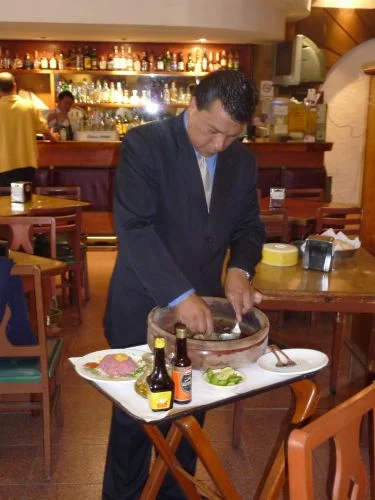
Mexico City may not be the first place you think of when you hanker for steak tartare. But the best I have ever had is at a cantina called El Portal, at Calle Chiapas #174, almost at the corner of Medellín, in the Colonia Roma. It is a version laden with condiments, among them garlic, anchovies, mustard, lemon and capers. And you must ask for it to be prepared by Rubén, the captain of the waiters, pictured above, at work.

Here is the finished version. El Portal has a full bar, and a couple of decent Spanish red wines to accompany the red meat. There is also a very good free-of-charge botana to go with your drinks (although the tartare, at 100 pesos, strikes me as a bargain).

El Portal is generally a tranquil cantina. The other day, however, one of its patrons thought it would be amusing to show us his impersonation of a "look-Ma-no-hands," no-fisted drinker.
It was good enough for D.H. Lawrence

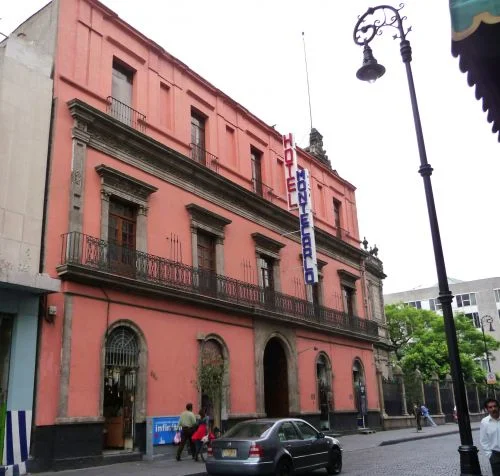
Readers of Mornings in Mexico may recall that this is where D.H. Lawrence slept when he passed through Mexico City in 1923. The Hotel Monte Carlo, on Calle Uruguay in the centro histórico, still seems to be good enough for French backpackers and the sort of couples excited by the smell of mildew during their trysts. However, no matter what your scene, the hotel, whose rooms cost about $15 U.S. at the current exchange rate, has seen better days.

Reading the city

Phil Kelly, an Irish artist who has been in Mexico City for about 25 years, opens and closes "Making a Scene," the chapter in First Stop in the New World about contemporary art. He arrived here with $50 in his pocket, half of which he spent on a hotel room, from which he telephoned English-language schools until he got a job as a teacher.

At the time he spoke no Spanish, so he began a process he calls "reading the city" -- traveling by metro, microbus and on foot, all over town, immersing himself in the observation of "the physical way in which people existed day by day." Volkswagen taxi cabs -- which were yellow in those days -- and palm trees became Phil's obsessions, "emblems," he says, "that reflected the exuberance and the freshness of the city."

When I met him, almost twenty years ago, I was immensely inspired. There is no writer who guided me to my own vision of Mexico City as clearly as Phil did. He had come here, seen the city in a unique way, and made it his own. At the time, after many years of living hand to mouth, he was only beginning to make a living as an artist. Today, he sells as many paintings as he can produce. He has had solo shows in the Museum of Modern Art and the Museum of Mexico City, has exhibited all over the country and is represented in galleries in Dublin and London.

Down by law

Diligent readers of this blog know that when I am not a writer, I am what is known as a mitigation specialist. I do investigations for lawyers who defend clients -- principally Mexicans -- who are facing the death penalty in the U.S. Among the defendants' families, friends, colleagues, classmates, teachers, doctors, priests and nuns, I look for mitigating circumstances, in the hope that these details will help spare their lives.

Sometimes in the course of the investigations I find myself in sections of towns where some of the bottom fishers of the legal professions operate. These two photos were taken near the intersection of Tulane Avenue and Broad Street in New Orleans, where Central Lockup, the city's holding prison, is located. And where, when I was 20 years old, I spent a fateful night, charged with, according to the arresting officer, "aggravated stupidity." But that's another story.