Bucket shop

julian


For the past 28 years, each weekday afternoon, Julián Sánchez, a portly man in his late 40s with salt-and-pepper hair and a moustache, exhorts passersby to buy food from buckets he has set up at a little table on the corner of Calle Dakota and Calle Yosemite in the Colonia Nápoles. “Come on, boss, what are you having?” he’ll say as he doles out meals. “Aren’t you hungry?”


He hardly needs to shout. At lunch hour there is almost always a cluster of a dozen or more people either eating or lined up to buy the food, which has been prepared by Julián’s wife Rosita. With a stoic expression, she collects the money, her hand covered in a plastic glove. Her severe visage may be due to the fact that she awakens every day at 4 a.m. to prepare the victuals, while Julián refers to his role in the operation as “the orchestra conductor.” (Rosita was ill the day I took this picture. Their daughter Elizabeth assisted.)


There are various elegant restaurants in the Colonia Nápoles, but Rosita’s is hands down the best inexpensively-priced food in the neighborhood. Each day she and Julián offer variety as well as quality – they may have pipián de puerco (a pork stew in a mild chile sauce) with nopal cactus; chicken in green mole; meatballs in chipotle, and breaded chicken cutlets in green sauce. These dishes are sold as fillings for tacos, or on Styrofoam plates with rice and beans. “We don’t have a set menu for every day in the week,” says Julián. “We keep changing it up so the people don’t eat the same things every day.”
Seasons

spring-5

When I was a boy, I saw the actor Robert Vaughan, who had made his name as Napoleon Solo, one of the spies on a show called The Man from U.N.C.L.E., being interviewed on TV. He said that he had moved to Connecticut from Hollywood because he wanted his children to witness the change of seasons.


more-spring-7

Even though I was only a child, his remark struck me as smugly irritating. It was as if he felt there was some moral superiority to places in which, at certain times of the year, the leaves changed, snow fell, etc. What was wrong with places that had a temperate climate? Would it be so awful to live where the weather was nice all year round?


spring-3

Mexico City has a delicious climate. Nonetheless, its residents constantly complain about the weather. When there is the slightest suggestion of heat in the air – on a sunny day that would make most citizens of the world delightfully happy – they say, Hace un calor de los mil demonios (It’s as hot as a thousand devils). At the first faint breeze, they whip out their scarves and knit hats and say Hace un frío de los mil demonios (It’s as cold as a thousand devils). (I guess the Catholic upbringing makes them hell- and devil-obsessed.)


spring-2

As temperate as the weather is here, there are marked seasons, although they are not the same as the ones that Robert Vaughan’s children had the privilege of enjoying. From June through September, it will reliably rain every day. With luck, it will be a thundershower that lasts only an hour or so in the afternoon. Occasionally it rains day and night. Once in a while there are huge storms, with hailstones the size of blueberries.


more-spring-3

Between October and January, the weather is usually excellent, but there are winds that cause leaves to fall from some trees. Late at night, and particularly early in the morning, it can get quite cold – at least what passes for cold in these parts. It might go down to 45 Fahrenheit (around 7 Celsius).


more-spring-6

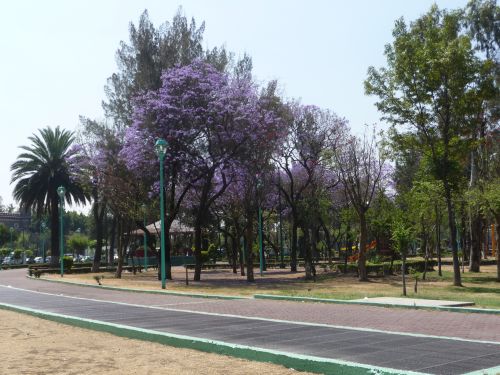
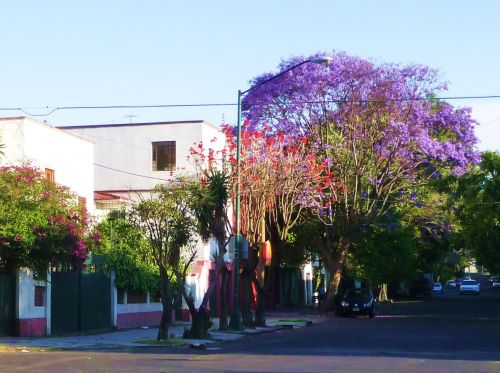
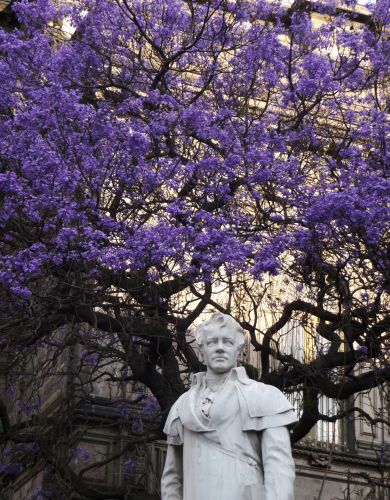
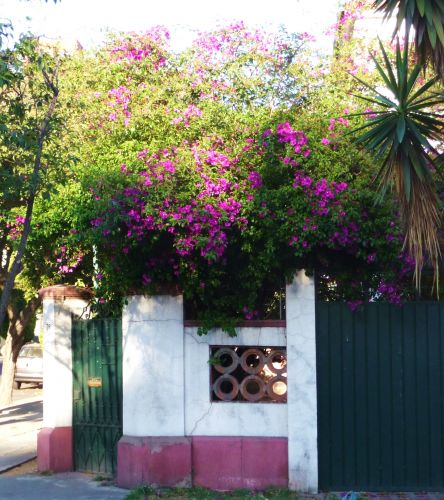
Spring is my favorite time of year. By late February, and throughout the month of March, jacaranda, bugambilia and colorín all bloom. The temperatures are perfect; warm but not hot. At night you only need a light jacket, if anything at all. These photos were all taken in those months. In April and May, before the rainy season begins, the air dries precipitously and it is the hottest time of year. That’s when you start to hear about those mil demonios.

In every kiss a revolution

lesbi-2

In 1991 I was hired by the Los Angeles-based magazine The Advocate to do an article about gay and AIDS activism in Mexico City. In those days, the capital was considered a zone of tolerance for homosexuals, compared to the cities of the conservative heartland. At the same time, gay bars were frequently raided. Cops would shake down the patrons, primarily closeted, and threaten them with exposure if they didn’t pay.


lesbi-5


For the most part, lesbians didn’t even exist. Not in the open, anyway. They were mostly married women who had affairs with each other in secret, or those academic-librarian types whose sexuality did not appear quite determinate. There was one bar for gay women in the city, but by the time the article hit the stands it had closed down.


lesbi-1


Things have changed in Mexico City. Particularly for younger people, who have grown up with the internet, and have access to so much more information than previous generations. On March 21st there was a lesbian parade in the center of the city. The sign at the forefront said, “In every kiss a revolution.”

Vote for Homeboy

tepito

My friend Federico Gama, who I believe is the best photojournalist in Mexico City, is responsible for many photos on this web site, including the one above. He is up for The Grange Prize this year,  which "focuses on the best of Canadian and international photography." Readers, we can all help him win. Click here if you want to know more about the prize, or click here if you want to go directly to the page where you vote for him.  Don't think about it. Just do it.

It was good enough for John Wayne


lf3

In a letter written in 1952, S.J. Perelman described Acapulco as “a dreadful place, the epitome of touristic enter­prise: gouging, arrogant mid-Western trippers, diarrhea, heat, and poverty and filth peeping out behind a Miami Beach facade.” If he could see it now, he would surely do headstands in his grave. The Costera, as the boulevard which lines the beach is known, is the nightmare por excelencia of tourist overdevelopment, with every inch of space sold to the highest bidders -- principally developers of condo towers; owners of tacky, overpriced restaurants, and the sort of bars where spring breakers of all ages, in any season, drink 3 for 1 margaritas in fish bowls until they either vomit, bungee-jump or do both at once.

lf6

High in the hills near the old center of town is an oasis called Hotel Los Flamingos. It is sufficiently far from the chaos of the Costera that no neon lights are visible, and the only sounds are the crash of the waves below and, in the early morning or late afternoon, piercing birdsong. Los Flamingos was built in 1930, but in the 1950s was bought by several Hollywood stars who had fallen in love with Mexico while shooting films here. Among the owners at the time was Johnny Weismuller, who, as Tarzan, actually swung from vines in the Acapulco area.

lf4

John Wayne was another Los Flamingos stalwart. The lad in the photo with him, who I imagine is now in his 60s, is the current owner of the hotel and on the premises daily.

lf5

From nearly all of the rooms, and the hotel’s bar, pictured here, you can see the most spectacular sunsets.

lf10

Tarzan, move over. As Anne Sexton wrote, "The sun of this month cures all."

lf2

The Flamingos, built on cliffs 450 feet above sea level, is nowhere near the beach but has this delightful kidney-shaped pool. You have to be a little insistent if you want them to bring you towels, and also need to exercise patience after ordering something from the bar.


lf7

My favorite Mexican writer, Jorge Ibargüengoitia, wrote that "Dentro de lo horrible, Acapulco siempre ha sido maravilloso," which more or less translates as, “Regardless of how horrible it is, Acapulco has always been marvelous.” This is a view of the sunset from the terrace of my room. Click here to get to the Flamingos’ website.