Michael Parker guest blog

mugshot

Pictured in the mug shots above, Michael Parker moved to Mexico City a little over a year ago, by way of Virginia, Texas and New York. He lives in the centro histórico in an apartment that he shares with a cat and what is probably the world’s largest collection of muzak – some 1,500 albums, of which he has downloaded 28,700 songs onto his computer. Parker, who works principally as a translator, also writes the gossip column for the English-language monthly Inside Mexico, and has an encyclopedic knowledge of the centro’s cantinas (no mean feat for someone who arrived so recently). A little while ago he shared his observations about something he observed on the metro, and allowed me to reproduce them here:


So I was returning home on the subway this afternoon, minding my own business.


Then I see this spectre (filthy) get on the train with his six-year-old son (also filthy). Dad is shirtless, which I didn't really care for on the subway. Then he walks by and I see his back is rent with bleeding wounds and open sores, not unlike a Holy Week self-flagellate. I winced.


"Pardon my intrusion...," he began and then he unfurled a bundle of broken soft-drink bottle shards, like a cache of blood-besmirched jewels, which he spread across the subway car floor. Yes, we were in for a floor show.


I caught the eye of a teenage girl on the bench across the way and she looked at me imploringly, helplessly. We girt our loins for what we knew was coming.


The train all the while hurtling beneath the city, Mr. Dad stood on his hands during two or three seconds; then somersaulted down onto the glass with a lucha-libre-worthy thud. He lay there for a few seconds, then stood and allowed the boy to pull the glass out of his back. Junior gingerly returned the shards to their original quarry. I presume his delicacy was to avoid cutting himself. 


Apparently there's a market for this sort of gruesome entertainment--he collected from two patrons. 

Life as a lucha

dos-luchadores

Photo courtesy of El Museo de la Ciudad de México


Even if you are not a huge aficionado of wrestling, you will probably enjoy the exhibition which is in El Museo de la Ciudad de México on Calle Pino Suárez in the Centro Histórico until the 11th of January next year. It tells the 75-year history of the World Wrestling Council in Mexico, through photographs, movie clips, masks, magazine pages, interviews, signs, programs and so forth. There are also current artist’s renderings that highlight lucha libre iconography. My favorite part of the exhibition was finding out some of the names of Mexico’s most prominent wrestlers, such as The Communist from Pachuca, the Nazi Destroyer, Hurricane Ramírez and Cyclone Mackey.


 mascara


Meanwhile, I was walking down Calle Salvador the other day and spotted this fellow, apparently dressed for work (although what sort of employment he may have remains a mystery). I asked if he would let me take his picture, and he obliged, but preferred not to answer any questions.

Tons of fun

tell-mama

Photo by Everett McCourt

The other day a friend named Nuria Quella sent me an email pointing out that in Mexico City, 75 percent of women, 69 percent of men, and 35 percent of school-age children are overweight. Because of that, INMEGEN, the National Institute of Genome Medicine, is beginning a study among chilangos this November, trying to break down the obesity genome to see if it is possible to prevent obesity-related diseases, such as asthma, hypertension and diabetes.

Here’s my shocking confession, amigos. I don’t even know what a genome is. Believe me, I’ve tried to figure it out. I’ve read, I’ve done research. But the information goes in one ear and out the other.

However: Can we get real for a minute? I know some people will excoriate me for saying this. Chilangos are fat because they eat truckloads of junk food (both sweet and salty), are in a photo finish with the gringos for the highest per capita consumption of soda pop in the world, gorge on greasy tacos (however delicious they may be) and are loath to do any exercise. Wouldn’t a little behavior modification go a lot longer than genome research? I'm an ignoramus about science; I'm just asking.

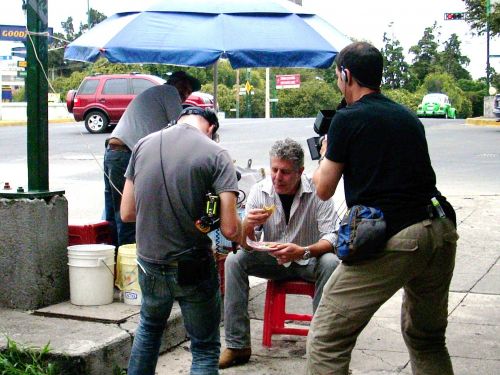
Anthony Bourdain in Mexico City

10-sept-009

A few weeks ago I got a call from a production company in New York. Called Zero Point Zero, they make Anthony Bourdain’s show No Reservations. They were wondering if I might be able to help them out while preparing to shoot a program in Mexico City.

They didn’t have to ask twice. I admire Bourdain and, having spent a couple of years of my youth working in restaurants, believe his book Kitchen Confidential is essential, one that had to be written. He is also one of the few people in the world I envy: Who wouldn’t like to be paid to travel around the world and eat?

In any case, I not only recommended some of my favorite restaurants, cantinas and stalls for eating street food, I was also able to spend some time with the crew while they were in town shooting. Bourdain – who everyone calls “Tony” – did not disappoint. Indeed, he fulfilled all expectations. The Lenny Bruce of cookery, he frequently spoke in uninterrupted monologues full of jokes of a scatological or sexual nature (sometimes both), jokes that would probably result in a lawsuit if I were to repeat them here.

The show is set to air early next year. Tony is pictured above sampling what is known as a taco sudado – a “sweaty taco,” so-called because after being fried in the morning they spend the next hours steaming in a basket until they sell out. They are the cheapest tacos in Mexico City and, in my opinion, sublime. There will be another post at a future date about Juan Monsalvo, the sweaty taco salesman under the umbrella.

Miguel Angel and San Charbel

june-6-016


A few years ago I read a review of a film called Game Six, and although it was not very favorable, I wanted to see it because its script was written by Don DeLillo, a writer I admire. I lamented that this was precisely the sort of small independent film that would never in my wildest dreams make it to Mexico City.

Six days later, I was having lunch in a cantina in the Colonia Narvarte called La Mansión de Oro. A man whose face indicated a great deal of life experience entered, and began to circulate from table to table. From a satchel, he was selling piles of pirated DVDs of recent films. Most were the usual suspects – the latest releases from Disney, action movies, blockbusters based on comic book characters. But there were also art movies from France and Japan, a smattering of black-and-white classics, and – lo and behold – Game Six.

After I made my purchases, the salesman, whose name is Miguel Ángel Zamora López, gave me a little card bearing the image of San Charbel, a Lebanese Maronite monk who was enshrined in 1977 by Pope John Paul II. He has become one of Mexico City’s most popular saints in recent years. (There are some 400,000 Mexicans of Lebanese descent, and they were the first to embrace Charbel and include him in their masses.) Miguel Ángel, pictured above, is one of the saint's truest believers.

After buying the film I invited Miguel Ángel have a drink with me. He told me he hadn’t touched alcohol in 17 years, so we made a date to have a coffee later that week. His dramatic story – and that of San Charbel – are in my book First Stop in the New World.