Law

bar

Besides being a writer, I am also a mitigation specialist. Principally, I assist lawyers who defend Mexicans facing the death penalty in the U.S. I go to the towns where they are from and interview family, friends, teachers, classmates, colleagues, nuns, priests – anyone who can give us information that might inspire mercy in a jury, in the hope that they will give them life without parole instead of a death sentence.


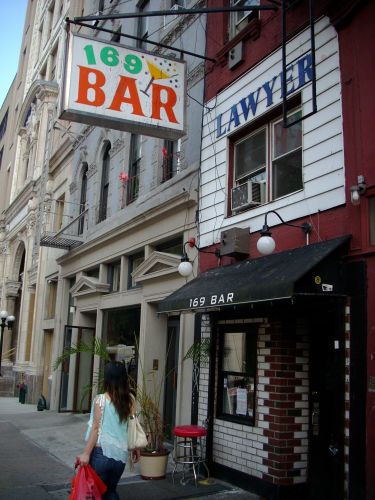
Since emarkbing on this work, I have become ever more attentive to legal matters. Therefore, I couldn’t help but notice this two-story setup on East Broadway, on the fringes of Chinatown in New York, across from Seward Park. It would appear that in New York State, when they talk about “passing the bar,” they are not kidding.
Music, maestro, please

norteno


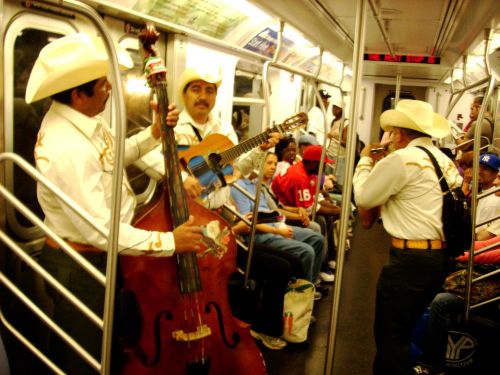
I was in New York last week for a brief work trip. On the #2 train between midtown and Harlem, this trio norteño entered and played a spirited version of La bamba (which is actually a canción jarocha from Veracruz. Still, they have to cater to the crowd: La bamba is probably the best-known Mexican tune among gringos after Cielito lindo). I told the bass player that I live in Mexico City and that there are a lot of itinerant musicians on the metro there. “I know,” he said. “There are too many of us. That’s why we’re here.”

Nothing to hide

july-31-048


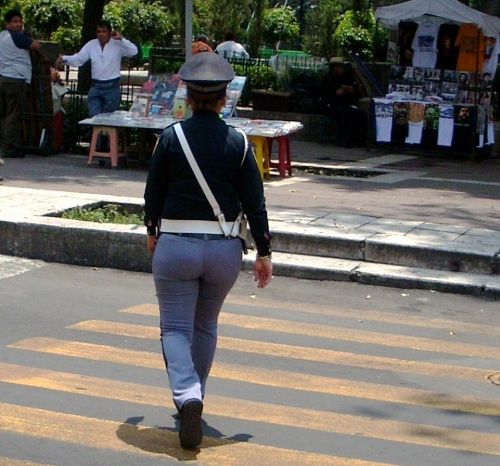
Last time I checked there were 80,000 police to protect the eight million residents of the Federal District. (El D.F. is only the central part of greater Mexico City, with its population of 20 million.) There may be more cops today; before he was elected mayor two years ago, one of Marcelo Ebrard’s campaign promises was to increase their number to 100,000.


This is an off-the-charts per-capita ratio compared to other big cities. According to a New York Times report in September of 2006, nine thousand police officers were enough to protect the four million residents of Los Angeles, and New York made do with 37,000 for eight million citizens.


Mexico City cops come in a dizzying variety: preventive police, investigative police, transit police, tourist police, mounted police, auxiliary police, bank police, diplomatic police, industrial police and customs police, among others, each corps with its own uniform.


In the last decade or two, the police department stepped up efforts to hire more women. Mexico City law enforcement is legendarily corrupt, and apparently, the logic was that females are less prone to bribery and other commonplace forms of malfeasance (a notion that tends to be laughed at by Mexican males).


One thing is certain – policewomen are given uniforms with pants so tight that, regardless of whatever infractions of which they might be guilty, they would never be able to get away with smuggling.

Another endearing “negrito”

tete-de-negre


My post of July 31 about the words and phrases that Mexicans use to refer to people from countries and ethnic groups aside from their own inspired more comments than any other that I had previously published. More than a dozen people contributed their thoughts.


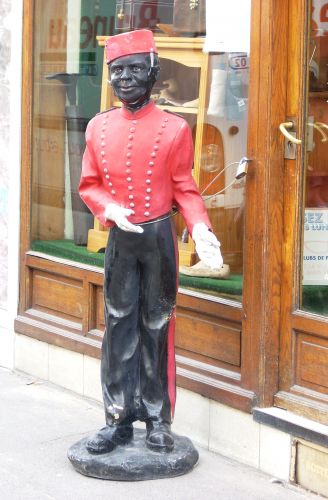
For some perspective, I thought it only fair to exhibit this photo of a statue outside of a shoe repair shop in Paris. It is located around the corner from the Cambronne metro station (and the apartment where I stayed for a few days last September).


I visited Paris for the first time in the early 1980s. In every pastry shop, there were round, ball-shaped cakes, covered in chocolate, on trays with the enticing legend, “Tete de negre.” In French, tete means head, and negre is the aggressive word for a black person, equivalent to the reviled n word in English (as opposed to noir, which literally means black and is the more politically correct form of expression).


Usually, when I brought up “tete de negre” to a French person, he would become flustered and impatient with me, and make a disparaging remark about people from the United States, and our obsession with being politically correct. Yet last autumn in Paris – the first time I had visited France in five years – I noticed that the bakeries were no longer selling tetes des negres. The pastries had at some point been reassigned much blander names, such as boule de chocolat (chocolate ball).


The black bellboy in the photo, however, presumably knows his place and has stayed put.