Night of the living uniforms

oscar-52

(Photo by Everett McCourt)

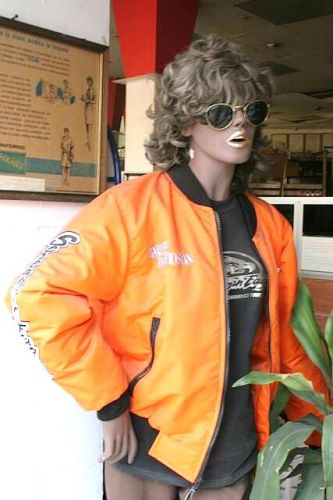
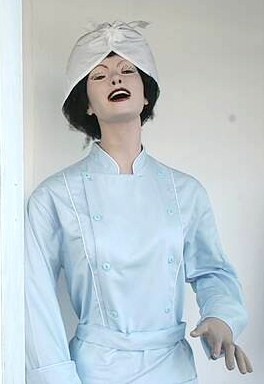
When out-of-towners come to visit me, I send them off to the Anthropology Museum or Frida Kahlo’s house by themselves, and catch up with them later for lunch at the cantina. But one “gallery” where I have accompanied friends countless times is Oskar, a store on Avenida Insurgentes and Calle Chihuahua in the Colonia Roma. Here you can buy uniforms of any kind – night-duty nurse, coffee-shop waitress, French chambermaid, eager bellboy, pit-stop girl and the like.
oscar-1

(Photo by Everett McCourt)

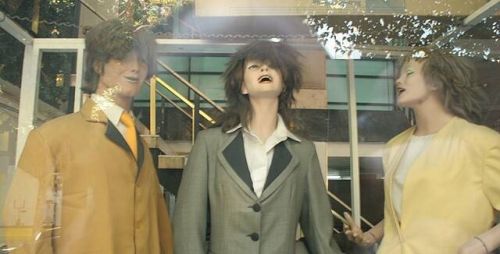
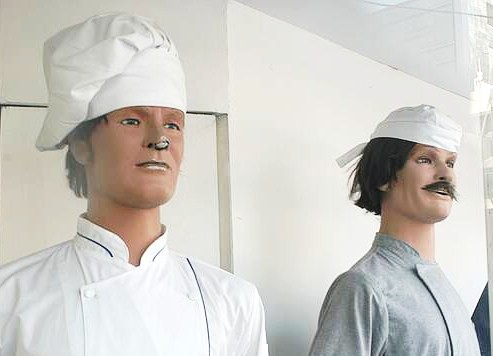
All the mannequins appear to be about 40 years old and wear wigs with the corresponding decades of neglect. They look like shipwreck survivors, or people who've had their hair cut with a lawnmower. Their hands – those that still have them – tend to make expressive or even extravagant gestures, sometimes bent into positions impossible to duplicate in real life. Some are in disturbingly suggestive poses.
oscar-4

(Photo by Everett McCourt)

If you are interested, there is a little more about Oskar in my book, First Stop in the New World (see books page). A word of warning: If you come here hung over, it could be a little frightening. It's almost possible to imagine the mannequins as human beings. Oskar would be a great setting for a horror movie, with the protagonists trapped inside and the mannequins coming to life.
oscar-3

(Photo by Everett McCourt)

Pruned

cubist

No self-respecting tree in Mexico City is allowed to grow wild. The cubist models pictured here are a testament to the tonsorial obsessions of the people who attend to nature around here.


mushroom

The flying saucer look, aka the mushroom, is in this year.


april-12-003

So is the marshmallow line-dance. The photo above is actually in Celaya, Guanajuato, but you get the idea.

“Zotz” and other gems

books

On Calle Donceles in the centro histórico, there are over a dozen second-hand bookstores. Obviously most of their stock is in Spanish, but each has at least a small section of books in English (and some in French and German). They are the detritus of the dead of the last century or so; a shopper can go back in time to peruse the forgotten titles that were the bestsellers of their day: Must You Conform?, What to Wear Where, The Case of the Grinning Gorilla.

I've seen literally dozens of copies of John P. Marquand's The Late George Apley, Pearl S. Buck's The Good Earth and Vicki Baum's Grand Hotel. Even more of Be My Guest by Conrad Hilton seem to have washed ashore here. (Perhaps that is unsurprising as a copy was left in every Hilton hotel room for decades.) A 1947 novel by Walter Karig called Zotz has turned up variously on the street -- as it has at roughly half of the used bookstores I have ever been to in my life, all over the world. I've found little gems: Penguin editions of Wodehouse or Joseph Mitchell's McSorley's Old Ale House, both Butterfield 8 and Appointment in Samarra by John O'Hara, numerous Orwells and even more Graham Greenes.

I have never been a collector and am completely ignorant about the value of old books. At one Donceles store, a friend and I came upon what appeared to be a first edition of The Great Gatsby -- Scribner's, 1925, in fair shape in what may have been its original binding. It was priced at 300 pesos, about $30 US. Neither of us had much cash on hand so we let it go. I returned for it the following day when it was, needless to say, gone. A rare book dealer in New York told me that even in so-so shape that book is worth fifteen hundred bucks.

Two exhibits in the Centro Histórico

federico


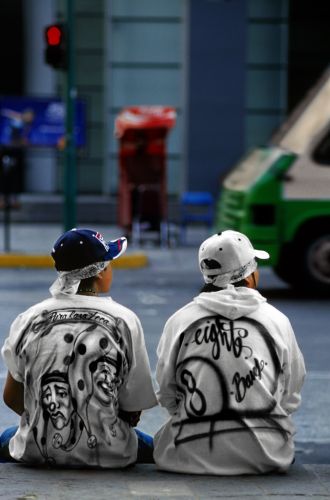
My friend Federico Gama, a collage of whose Mexico City photographs is on the “about” page of this website, has a couple of pieces in an exhibition called Identidades y Fronteras en Iberoamérica (Identities and Borders in Iberoamerica), at the Centro Cultural España on Calle Guatemala #18, behind the Metropolitan Cathedral. It is an unsettling show of photographs that documents various groups of Latin Americans, who travel to other places to find a different life. (Most of them go to other countries, but one of Federico’s obsessions is photographing youths from towns and cities around Mexico who come to live in Mexico City. Two of them, whom Federico refers to as Mazahuacholoskatopunks, are pictured above.) Federico has just begun a blog, the link to which is on the list of “Friends” on the right-hand side of this page. The exhibit is up through the end of August.


Ana


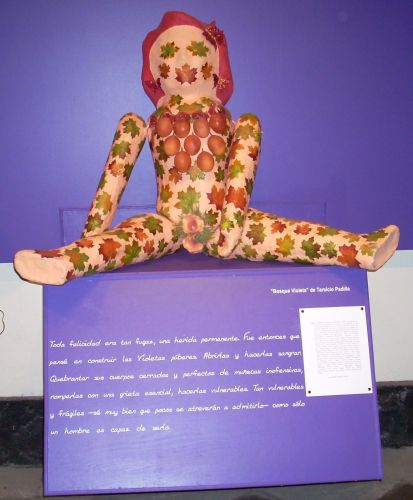
Meanwhile, around the corner, at the Coordinación de Literatura de la INBA on Calle Brasil #37, is an ingenious exhibit based on the novel Las violetas son flores de deseo (Violets are Flowers of Desire) by another friend, Ana Clavel. Ana’s book is about Julián, a man who sublimates his desire for his pubescent daughter, Violeta, by creating a series of dolls inspired by his cravings for her. Ana convinced a series of artists to make sculptures based on Julián’s dream-dolls. The show is on through August 15th.

How do you say soju in Spanish?

Soju

Mexico City may not be as international as London or New York, but it gets more multi-culti all the time. I recently went to a Korean bar and restaurant called A Cu Yung, on Calle Río Panuco, almost at the corner of Río Ebro, in the Colonia Cuauhtémoc. I had brought a friend along for her birthday dinner. We were the only non-Koreans in attendance.

Menu

The waitress handed us menus in Korean, and apologized for not having any in Spanish. So we asked her what they served, and in a quite halting version of her second language, she more or less explained some of the highlights on the menu (seafood soup, fried chicken, the Korean seafood pancake known as haemool pajeon). The dishes are quite large, so if you want to try more than one thing it is best to go with three or four people.

Bob

I realize how much I have adapted to Mexico City – even though I am a gringo, I no longer think of myself as a “foreigner” around here. Yet at A Cu Yung anyone who isn’t Korean is the “gringo.” Being there felt inordinately cosmopolitan, even like a cheap trip to a foreign country. Many Koreans are heavy smokers, but recently a law was passed banning smoking in bars and restaurants in Mexico City. Above is the restaurant's shrine to smoke, complete with Mr. Marley in the act and various brands of imported cigarettes, real and chocolate.