The difference between L.A. and el D.F.

la-022.JPG

I recently passed through Los Angeles and one afternoon was driving around Hollywood with D.T., a chum from my school days. Happy hour was upon us, so we decided to repair to the Formosa Cafe, my favorite bar in the city, and one of the few that still looks more or less the same way as it did in the 1940s. (It is in fact such a museum piece that it has been used as scenery in various period films, including L.A. Confidential.)

At a certain stretch of Formosa Street, D.T. saw a sign warning that he wasn't allowed to make a right turn. There was no visible reason why not, he groused, and he didn't feel like driving around in circles, so he decided to make the turn anyway. I mentioned that this sort of logic and his subsequent unlawful action would make him not only a typical but an exemplary driver in Mexico City.

la-037.JPG

However, unlike in my home town, on Formosa Street there was a patrol car lying in wait for just the sort of miscreant who would dare to make an illegal turn. No problema: D.T., showing that he is at heart a chilango, simply stepped on the gas and tried to lose the cop in traffic. My heart leapt at the idea of getting into an actual Hollywood-style car chase in actual Hollywood.

Unfortunately the patrolman caught up to D.T. on Santa Monica Boulevard. He wrote him up a ticket for a stiff fine. D.T. will have the opportunity to take an on-line traffic course which, if he passes, will result in his getting the infraction stricken from his driving record.

la-039.JPG

Had D.T. actually been caught making an illegal turn by a Mexico City traffic cop, profuse apologizes and a 100-peso note (worth about $10 US) - "para el refresco"  (so the cop could "buy himself a soft drink") - would have been sufficient to settle the matter on the spot. Here D.T. enjoys a martini at the Formosa after the fireworks were over.

¡Ya llegó!

cover-llaves.jpg

When I came to Mexico City in 1990, with limited knowledge of Spanish, I knew that I wanted to learn to the language well, and to be able to read anything from Don Quijote to One Hundred Years of Solitude in the original. But I never dreamed I would one day write in Spanish, let alone that a prestigious publishing house like Sexto Piso would consider my work worthy of a book. But here it is. Las llaves de la ciudad is a collection of pieces I wrote about Mexico City in the last few years, published in various magazines and newspapers here. The great majority of them are portraits of people: the proprietor of the first and only boutique in the world that sells nothing but bulletproof clothing; Alín, a deaf-mute transvestite who has invented her own sign language and sells her company in a beer joint; Viviana Corcuera, who was Miss Argentina in 1964, and for close to 40 years has been Mexico City's most notorious socialite. Each of these people is a stone in what, in the book's totality, becomes a mosaic of Mexico City.

For the moment it is only available in Mexico, at most major bookstores or if you click here. It will shortly be obtainable on Amazon; please watch the books page for its progress.

Sweets for the sweet

june-30-003.JPG

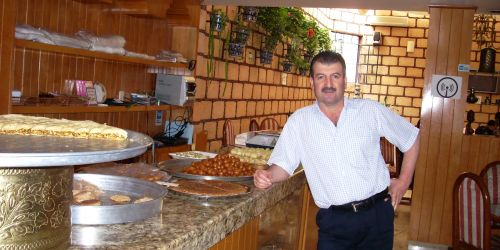
There are about 400,000 Mexicans of Lebanese descent, and most of them are in Mexico City. My favorite is Achmed, pictured above, the manager of the Al-Andalus restaurant on calle Nueva York in the Colonia Nápoles, in walking distance from my apartment. The original, and more splendid, branch of the restaurant is in the centro histórico. They have everything there, except Achmed.

No matter how infrequently I go to Al-Andalus, Achmed always greets me as if I ate there every day, indeed as if I were part of the family.

When Jabbar Yassin Husin, an Iraqi writer who lives in France, visited Mexico, we made a date to have coffee together at the apartment where he was staying. He asked me to bring him some kind of cake or cookie, so I went to Al-Andalus and got an assortment of Lebanese pastries. When I told Achmed that I was bringing them to an Iraqi, he had me take him a particular cookie. He professed that at Al-Andalus the cooks prepared more delectably than they do in Baghdad.

The last thing Jabbar expected was traditional Middle-Eastern pastry in Mexico City. He fell into a Proustian swoon and insisted we go to visit Achmed. The two of them, and a couple of other men, sat for hours speaking Arabic, as if they were all old friends, shooting the breeze around the corner from the souk.

El Barrio

june-11-016.JPG

Briefly away from Mexico City, let's continue with our tour of uptown New York. Harlem has, of course, a fabled history as the most important black neighborhood in the United States, although these days Manhattan real-estate prices are so high that some blacks are being edged out by whites. But that is in the central and west sides of town. The east side of Harlem became known as El Barrio, or Spanish Harlem, in the 1960s due to a huge influx of Puerto Rican residents. These days, the area is pan-Hispanic.

I happened to take a walk there the day before an unofficial New York holiday called Puerto Rican Day. Up and down Third Avenue, as a sort of warm-up to the big day, they held a street festival celebrating Puerto Rico. The characters pictured above are a tropical equivalent of the Three Stooges.

june-11-019.JPG

La dieta puertorriqueña, aka a heart attack waiting to happen.

june-11-022.JPG

The above is an outtake from the film Babe: A Pig in the City.

june-11-029.JPG

Fifteen or twenty years ago there were hardly any Mexicans in New York, but now it's become más mexicana que nunca.

june-11-027.JPG

This is where you can get your fix of Jarritos, jabón Ariel or cacahuates japoneses. The furtive body language of the man pictured above indicates some ambiguity as to whether he is a shopper or a shoplifter.