Cantinflas ER

february-24-001.JPG

In the guise of a quick-witted scrapper from Mexico City’s starving class, a comic actor named Mario Moreno, known as Cantinflas, enjoyed great success throughout the Spanish-speaking world from the 1930s through the 1960s. Although Charlie Chaplin once called him “the greatest comedian in the world,” his films were practically unknown apart from Latin America and Spain. This is because of much of his humor is based on elaborate plays on words, as well an ability to speak at great length without actually saying anything. (His style of speech is so common among Mexican politicians that an adjective was coined for their discourse: cantinflesco.)

Outside of the Hospital Obregón in the Colonia Roma, there is a revolving statue of the comedian, a few yards from the emergency-room entryway. Why it has been placed there remains a mystery. Did hospital administrators think that he might cause a chuckle among the unfortunates who are about to go inside for treatment? Or that when a doctor gives a patient the bad news, it won’t seem so awful if he thinks of Cantinflas?

I never thought I’d see the day

no-smoking.JPG

Mexico City has always struck me as one of those places that welcomes the unapologetically inveterate smoker. Candy stands and newspaper kiosks sell single loose cigarettes on the street, and at 3 a.m. parties always degenerate into discussions about who knows a coke dealer that will deliver at that hour, and where is the closest convenience store to buy smokes. The anti-tobacco lobby had its place but it was condescended to, if not laughed at; I remember, for example, in a restaurant people blithely lighting up underneath a “no smoking section” sign.

Until now. Last month the City Assembly passed a law that banned tobacco from public places. Even more shocking, people are obeying without putting up a fight; even late at night, at bars and cantinas the customers go out onto the street for their tobacco fix rather than try to flout the law.

Some supposed intellectuals are making a stink about how the smoking prohibition flouts their “rights,” and a couple of journalists incurred the wrath of many when they compared the state’s sanctions against cigarettes to the Nazis and their concentration camps. While debate has been promised it looks like their arguments will quickly go up in smoke.

Brand-new Jew

armendariz.JPG

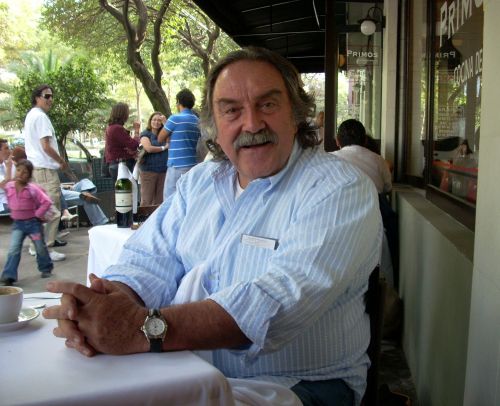
Like his father before him, Pedro Armendariz Jr. is a beloved movie actor. Since his debut in 1966 in Fuera de la ley (Outside the Law), he has appeared in about 200 flicks, playing private eyes and police detectives, soldiers and priests, sea captains and state governors and even Pancho Villa himself. He has acted in U.S.-financed extravaganzas filmed in Mexico such as The Legend of Zorro, Once Upon a Time in America and License to Kill. Yet in recent years, he has converted to Judaism – at least on the Mexico City stage, where he appeared in back-to-back long runs as Tevye the dairyman in Fiddler on the Roof, and Max Bialystock in The Producers. Here he is on a recent afternoon, savoring a coffee after a non-kosher lunch at the restaurant Primos in the Colonia Condesa.

Realism

Courtesy of Apocrifa.com.mx

Courtesy of Apocrifa.com.mx

When he told the newspaper La Jornada that his work isn’t meant to scandalize, perhaps the painter Daniel Lezama was being disingenuous. It is, after all, laden with Mexican iconography – the flag and its colors, the Virgin of Guadalupe, the most popular soccer teams – interlaced with nudity, implicit incest, blood and violence. The most disturbing aspect of Lezama’s work is how close it mirrors present reality. Here, in a detail from his painting La gran noche mexicana (The Great Mexican Night), he mixes women who protested nude on Paseo de la Reforma, one of Mexico City’s central boulevards, with a concert that pop singer Juan Gabriel gave in the zócalo, the central square.

Lezama is unusual in contemporary Mexican art. For one thing, he not only paints, he actually knows how to paint. (Painting tends to be treated with contempt here, while the installation is all-encompassing.) A provocative and disquieting exhibition of 40 of his works is on view at the Museo de la Ciudad de México (The Mexico City Museum) on Calle Pino Suárez in the centro histórico until the end of May.

Minnellium

LIZ MINELLI.jpg via artimagesfrom.com

Queens of a certain age here are beside themselves because, as part of her world tour, Liza Minnelli will shortly set foot on Mexican soil after a ten-year absence. Among her activities will be a concert at the Auditorio Nacional in Mexico City on April 28. One hopes that the fragile diva, who has been giving it all she's got for over 40 years, will not collapse and fall off the stage, as she did in Stockholm four months ago.

Then again, presumably the Swedish queens of a certain age who attended that performance will now have a story to tell their grandchildren -- or at any rate their grandneices and grandnephews -- which they would not have had if the concert had gone off without a hitch.

What I wonder is whether the 70s superstar has any idea that throughout Mexico there is a chain of boutiques that almost, but not quite, bears her name. The stores in Mexico City have been around for as long as I can remember. The clothing that they sell might be considered fashionable, or even glamorous, depending which turnip truck the beholder just climbed out of.