This photo was taken the other night at about three in the morning at a hole-in-the-wall taco stand on calle Bolivar, a street known for its myriad cantinas. Various different meats had been swirling in that deep fat since approximately one in the afternoon. For the uninitiated, they include slabs of suadero (a cut of beef from the lower part of the rib), extensive tubes of longaniza sausage, festively curling tripes and chunks of pork marinated in chile – all sizzling in the same deep grease. After you place your order, the murderous-looking taquero daintily dips the tortillas in the fat before heating them in the center of the grill, chops the corresponding meats with which to fill them, and voila. Before serving, he’ll ask if you want the tacos garnished with “vegetables.” (He’s referring to chopped onion and cilantro.) The traditional accompaniment is a water-based soft drink known as Boing, which comes in various fruit flavors. The one in the photo is mango.
Sign language
Much of public space in Mexico City has been raped. Enormous billboards are not only in your face on the inner-city highways, they hover over the main boulevards, and even in residential neighborhoods are painted on the sides of buildings or hang like banners over balconies and terraces. Others are pasted on walls hastily constructed beside empty lots.
Much of this signage is illegal, but tolerated. From time to time the city government makes a big noise about how it will soon be clamping down, but the efforts are largely limited to the expulsion of hot air. Even more occasionally the Ministry of Urban Development appears to believe that it is doing its civic by taking an action that would surely provide semiotics professors with material for at least a class: They paste large signs over the offending signs that make clear in bold type that they are there unlawfully. Thus, one eyesore partially covers another.
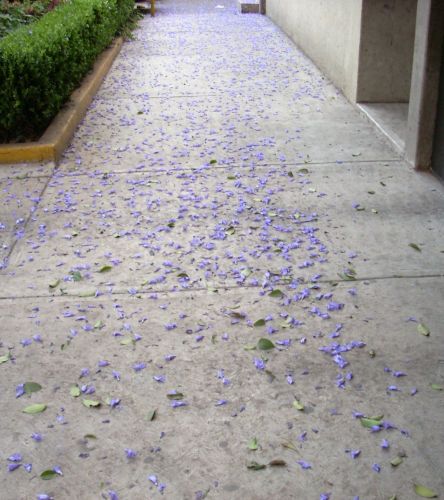
Magic carpet
Changes of season may not be as dramatic in Mexico City as in northern climes, but they definitely exist. This is a jacaranda tree. It flowers briefly in Mexico City, beginning in February. By the end of this month the lavender blossoms will have disappeared.
This is what the street looks like when the blossoms fall. That's why this is my favorite season in Mexico City.
Liquid lunch
Photo by Everett McCourt
This man is reputed to have a price on his head in Ciudad Juárez. He is not one of the responsible parties for the repeated murders of young women in that border city. Instead, he had the temerity to write a book about them, in which he presents reasonably credible evidence that very important people in Mexican government and law enforcement are at least implicated in those crimes.
The book is called Huesos en el desierto (Bones in the Desert) and was released a few years ago by Anagrama, the prestigious Barcelona publisher. It has been translated into Italian and French, but unfortunately not into English.
The author, Sergio González Rodríguez, has also published novels, books of essays and writes a weekly column for the newspaper Reforma about restaurants and bars. Pictured here in a traditional Iberian eatery called the Casino Español, located in the centro histórico of Mexico City, it is perhaps churlish for me to point out that he is drinking a shot of tequila, which serves as the chaser for the nearly empty vodka-and-tonic at his side. Both libations are warm-ups for the bottle of red wine burning a hole in the tablecloth. Note that González Rodríguez staunchly ignores the tortilla española and the bread on the table. This is his idiosyncratic version of a hunger strike, which he threatens to continue until the Juárez murders are solved.
El primer rocío de la mañana de un nuevo día
The taxi driver appeared to be 50 or 55, with cinnamon skin, whitening hair and the Clark Gable moustache still favored by many men of his generation. We’d been in traffic for ten minutes without exchanging a word, when suddenly he asked if I spoke English. I told him I did, figuring he would then want to know where I was from, what I thought of Mexico, and if preferred Obama or Hillary. But he surprised me, asking if I could translate the words to the song emanating from his CD player.
It was Barry White crooning “You’re the First, the Last, My Everything.” White is something of a hero here – you can find a pirated CD of his greatest hits at any market and most street stalls in the city. He isn't Mexico City's only American idol. The most popular oldies station programs the Beatles for two hours a day, and Creedence Clearwater Revival for an hour more. Other staples of the station are the more arcane “Xanadu” (one of Olvia Newton-John’s less fortunate numbers),and Gilbert O’Sullivan’s “Alone Again Naturally,” a song that enjoyed a vogue in the U.S. for a matter of months in the early 1970s. Its whimpering, self-pitying lyrics appeal to the most sentimental and lachrymose side of the Mexican character.
Spontaneous interpretation is a talent I have never been able to capture, let alone master. Panic sets in: It’s hard to keep up. By the time I translated en tí he encontrado tantas cosas, Barry White had long finished murmuring the next couple of lines. So I tried to explain to the driver that White’s lyrics had never mattered so much as the Love Unlimited orchestrations, and that indeed part of the fun was just surfing along with his growly purr, particularly when he elongated the word "love" as if it had five or six syllables. He looked at me with a gravely mistrustful expression. All he wanted to know was the meaning of the song's lyrics, and he found himself with an incomprehensible gringo in the passenger seat.