A new book about the failed drug war

narco

My friend Ioan Grillo is a British journalist who has lived in Mexico for ten years. As a reporter he has obsessively covered the drug-related violence here, and just published a book about the failure of the so-called drug wars, called El Narco: Inside Mexico's Criminal Insurgency. The book has received excellent advance notices from Publisher's Weekly,  Kirkus Reviews and Library Journal. I have only just begun to read it -- so far it's a real page-turner. Obviously, I tend to wait until I have finished a book to write about it here, but as Ioan starts a tour today, I wanted to post his dates in case he will be appearing in a bookstore or other venue near you.

Today, October 23, he is in Austin at the Texas Book Festival at noon at the C Span tent on Congress Avenue between 9th and 10th.

Tomorrow, October 24, he is at Brazos Bookstore in Houston, 2421 Bissonette, at noon.

On the 25th he is at Vroman's in Pasadena, California, 695 East Colorado, at 7 pm.

On the 26th, he is in San Francisco at the World Affairs Council, 312 Sutter Street, 6 pm.

New Yorkers: you have to wait until November 28, when he will be at the Half King, 505 West 23rd Street, at 7 pm.

Household saint

In his heyday in the 1950s and 1960s, the masked El Santo (The Saint) was probably the most famous wrestler in Mexico, if not in all of Latin America. In addition to his matches, which he fought worldwide, there was a comic book about his exploits, and he also starred in a series of over fifty B-pictures with titles like Santo vs. the Mummies of Guanajuato, Santo vs. the Vampire Women and Mystery in the Bermudas. Throughout his career he never lost a match (which would have required him to take off his mask in public). Although born in Hidalgo state, El Santo came to Mexico City as a child, and learned his chops in Tepito, a notoriously tough neighborhood that has been the breeding ground for many wrestlers and boxers. This statue, on the edge of Tepito, is a gift to the neighborhood from his son, another wrestler known as El Hijo del Santo (The Son of the Saint). Fans regularly leave wreathes in El Santo's memory, although he has been dead since 1984.

Shopping center city

Mall

The first shopping mall in Mexico City, the enormous Plaza Satélite, opened in 1971. In the past decade or so, the trend has been to build smaller malls in any neighborhood where the market will bear them. With slight variations, all Mexico City malls look alike and have the same stores, skewed toward younger consumers. Many such shops are branches of multinationals with headquarters in Europe -- stores you see in much of the world, such as C&A, Mango and Zara. (That last is part of the Spain-based Inditex Group, with more than 3,000 stores in 65 countries, including the Berksha, Pull and Bear and Oysho chains.)

For most of my life,  I had the New Yorker's contemptuous view of malls: loathsome eyesores for unfortunate hicks who live on the peripheries of cities and cannot even buy a newspaper without getting into their cars. However, after so many years in Mexico City, I can sort of understand the chilango's comfort in shopping centers. One of the principal sources of stress in the city is traffic, which makes it so complicated to get back and forth from anywhere. Since so many malls have sprouted, they are easy to get to. Some take comfort in their uniformity and predictability, and that once inside the bubble, their consumer needs are met -- needs that, before the appearance of the malls, were largely undiscovered. I understand the social status issues as well. Malls give certain chilangos the sense that they are part of an affluent contemporary universe.

Y tu mamá también

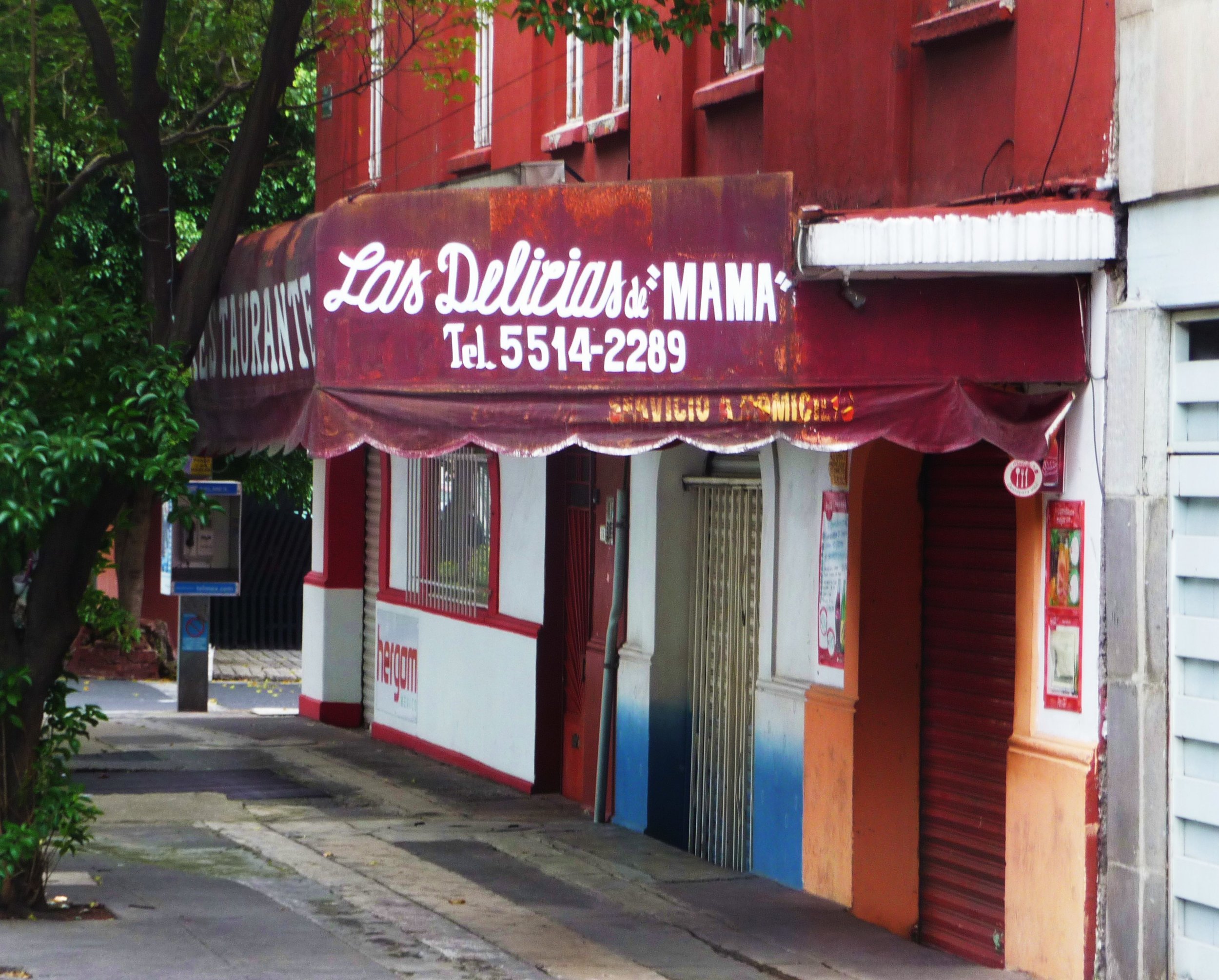
Toward the end of Nelson Algren's novel A Walk on the Wild Side, the hapless protagonist Dove Linkhorn finds himself in a New Orleans jail cell with an old con called Cross-Country Kline, who advises him that "life is hard by the yard" but "a cinch by the inch." Kline also suggests that "money can't buy everything. For example: poverty." The older man's advice is frequently quoted, reduced to three maxims: "Never play cards with a man called Doc. Never eat at a place called Mom's. Never sleep with a woman whose troubles are worse than your own."

I like poker, but the opportunity to play with a man called Doc has never presented itself (unless some shark was lying about his moniker). And let's just say that it has not been easy to find women with troubles worse than my own. But I tend to agree with Algren about restaurants called Mom's. They just don't inspire confidence.

And that goes for the abuelas too. There are plenty of them here in Mexico.