Garbo drank here, sort of

When it opened its doors in 1936, Ciro's, the nightclub on the top floor of the luxurious Hotel Reforma, became the most fashionable spot in Mexico City. Diego Rivera painted the murals on its walls. According to a book by Armando Jiménez, one night in 1944, management received a telephone call, putatively from the Swedish Embassy, that Greta Garbo was on her way, landing in Mexico City from an Acapulco holiday, and wished to remain incognito. "Garbo" -- in fact, a French model -- arrived with an entourage, rented the hotel's Presidential Suite, consumed various bottles of champagne and cognac, signed for them and disappeared without paying.

Tragedy as well as comedy occurred at the Reforma. Three years earlier, in 1941, W.J. Cash, a U.S. writer in Mexico City on a Guggenheim Fellowship, was found hanging from his necktie in the bathroom of his hotel suite. Although deemed a suicide, there is some controversy over whether or not his death was actually a murder. Cash was an active anti-Nazi -- he'd written dozens of newspaper editorials against them -- and at the time Mexico City was alleged to be a hotbed of Nazi spies.

The greatest tragedy is perhaps the demise of the hotel itself. Having been eclipsed by other luxury hotels along the Paseo de la Reforma, it has remained empty for decades.


Head's up

Does this display whet your appetite? I realize the photo is small and out of focus but that's a  chorizo lodged in the maw of the pig. The image almost makes me come around to Moses and Mohammed's point of view. Almost.

Iron women

april 2011 012

El Palacio de Hierro (The Iron Palace), the most exclusive department store in Mexico City, opened its doors in 1891. In 1997, hoping to update its image as a fuddy-duddy institution for aging women, it hired an ad agency to develop a campaign to attract a younger clientele. The resulting ads, plastered on billboards and bus stops all over town, depicted ivory-skinned women with fine European features, impeccably coiffed, painted and clad, staring defiantly at the camera. Accompanying tag lines included "It's easier to conquer a man than a mirror" and "There are two things a woman can't avoid: crying and shopping for shoes." Dominating the design of each ad were three little words: Soy totalmente Palacio (I'm totally Palacio).

april 2011 005

The campaign created controversy. Their cleverness was perceived as a guilty pleasure by opinion makers, who at the same time condemned the ads' image of women as manipulative bitch goddesses with insatiable shopping habits (another catch phrase was, "Luckily we're the weaker sex. The stronger pays when we go shopping"). Incredibly, almost fifteen years later, the campaign continues. The two ads above, aimed at graduating high-school seniors, are teaching family values to Palacio shoppers. One says, "You can copy my exam. But not my hairstyle." And the other, "I can give you the phone number of my ex, but never of my stylist."

Lorena

I miss performance artist Lorena Wolffer's didadict countercampaign from a decade ago, which featured a darker-skinned woman more typical of Mexico City, with the tag line Soy totalmente hierro (I'm totally iron). This ad depicted her frowning on a pesero, as the straphanger alongside breathes down her neck, with the phrase, "The problem is that you think my body belongs to you." Another simply asked, "Who teaches you to be a woman?"

Cherry blossoms

Cherry

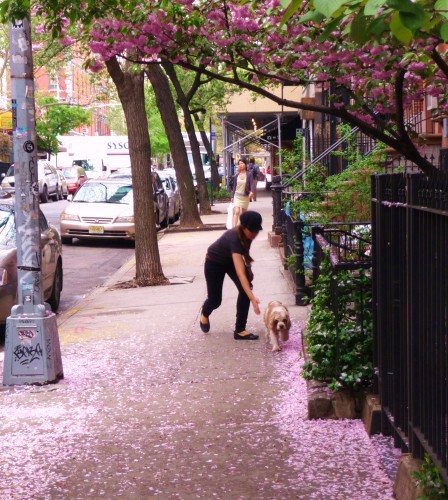
I passed through New York the last week in April. No matter what the weather is like -- and it changed every five minutes -- these cherry blossoms come out at that time of year. If you blink, you miss them. Their season goes by faster than the jacarandas in Mexico City. (I have blogged about the jacarandas -- on more than one occasion.)

Cherry 2

Still, when their petals fall to the ground, they leave the same "magic carpet" effect as the jacarandas.

Jessica

My friend Jessica Hagedorn has a new book out, a novel called Toxicology. For more information, click here.

Our Rodeo Drive

Some benighted tourists come to Mexico City and are overwhelmed to discover that there is a street -- Avenida Presidente Masaryk in Polanco -- where you can shop at outposts of many of the world's luxury retailers.


I am not sure what they expected from the capital of a country with one of the fifteen most active economies in the world -- guys in straw sombreros sleeping while burros drink from troughs?


At the dawn of the 21st century, multinational purveyors of sumptuous goods realized that Mexico's is one of the stablest economies in Latin America. And if it's true that half the people in Mexico City live in poverty, about ten percent of the population -- about 2 million people -- have an enticing amount of disposable income. Some of those people are obscenely wealthy.


At first the brands had an uphill struggle. Traditional Mexicans who are well-off enough to spend five thousand bucks on a Cartier watch are also in the habit of getting on a plane so they can brag to their friends that they bought it in Paris or New York. The best customers of the luxury boutiques here are the nouveau riche, politicians and drug traffickers. (The latter are a retailer's dream, as they pay in cash.)


Polanco, the neighborhood where Avenida Presidente Masaryk is located, is the most central upscale neighborhood in the city. As well as luxury stores, many of the city's best restaurants are there. Patronizing them is a delightful escape, however temporary, from some of the city's harsher realities.


Still, once you're out on the street, it won't be long until you're sent a four-alarm reality check. At a nearby traffic intersection, you're bound to see a five-year-old child selling Chiclets to drivers stalled at red lights.