Spoiled brats

No doubt that if any animal rights people read this they will want to shoot me. But does anyone else find it distasteful that, in a country where so many people can barely feed themselves, and so many others have malnutrition problems, there is a stand in the Parque México in Colonia Condesa where you can "spoil your pet" with gourmet treats? They cost 20 pesos per morsel -- some Mexican families' entire food budget for a day. All are made with rice, and are filled with chicken, beef, or veggies, and sprayed with an orange sauce.

From the other side of the ocean

The presenters of Top Gear, a lauded and well-received BBC TV show about cars, recently weighed in on Mexico. According to the program's three caustic commentators, you wouldn't want to buy a Mexican sports car because it would be "lazy, feckless, flatulent, overweight, leaning against a fence asleep looking at a cactus with a blanket with a hole in the middle as a coat."  Here's the BBC itself reporting on the incident, about which the Mexican ambassador to England demanded an apology.

For those of you who read Spanish, here's a slightly more detailed version from Yahoo.


Some of my Mexican readers seem to think that remarks like these are all in good fun -- when the joke's on someone else. When I posted about the Mexican use of the word "negrito," for example, quite a few Mexicans commented. They tended to think I was a clueless gringo affected by the U.S. disease of political correction, unable to appreciate the cultural nuances. What do you think about the remarks of our hermanos from England? As the queen might be saying in this picture, "Cheers my dears, and down the hatch."


Quezada at the Museo de la Ciudad de México

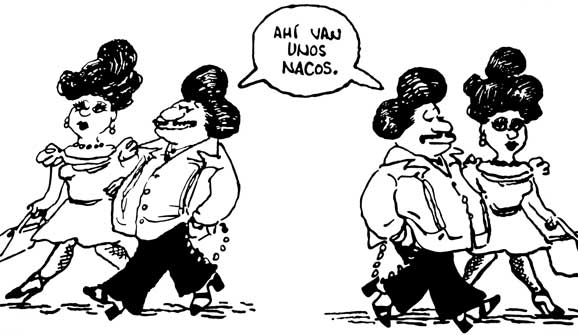
To call Abel Quezada Mexico's greatest cartoonist somehow undermines his importance. His medium may have been the newspaper caricature, but you could call him the Mexican Voltaire: a satirist and social commentator, possessed of a merciless rapier wit and profound wisdom about his country and his countrymen. He made fun of the powerful and the wealthy (among his favored personalities were Gastón Billetes, who wore a diamond ring on his nose, and the Dama Caritativa de Las Lomas, as well as any number of politicians) as well as starving-to-death journalists (so thin as to be barely visible except in profile), vendors of tacos de carnitas (replete with buzzing flies around their stands), bureaucrats, cops, mariachis, cowboys and supposed machos. He was also an accomplished painter and watercolorist. An exemplary retrospective of his work is on display at the Museo de la Ciudad de México (Pino Suárez 30, Centro Histórico) until April 3rd. Don't miss it.

Comida corrida

You've been working at home all day. It's about three in the afternoon, Mexican lunch hour. Do you want to start to disinfect lettuce for a salad, to cook a meal? I didn't think so.

Go out and get some fresh air. Around the corner are various luncheonettes where you can sit at a sidewalk table (or inside if you're sensitive to the afternoon breeze) and eat a multicourse meal. Have a refreshing glass of agua de jamaica -- water flavored with dried hibiscus petals and a little sugar.

First, there's the soup course. How about chicken broth with fresh vegetables? You can doctor it with that lime and some fresh salsa.

Then there's rice, made with tomato and garlic. This is the equivalent to the pasta course in Italy.


On to the plato fuerte -- the main dish. One of today's specials is chicken with green tomatoes, served with black beans.

The best part is the fresh tortillas that accompany everything.

If you're like me, you want to sit next to the grill, so you can get them while they're hot.

It's hard to get worked up over the dessert course -- usually it's jello or flan out of a package, as shown here. Still, it's nice to have a little sweet at the end of the meal.

There are at least a couple of choices for each course, and several for the plato fuerte. This was my lunch the other day at El Rico Sazón, on Calle Puebla between Veracruz and Tampico in Colonia Roma Norte. It cost 40 pesos -- a little more than three dollars, or two euros, at the current exchange rate. Of course 40 pesos is close to a full day's minimum wage here, but that's a perennial hard-luck story.