Don't tell Allah you ate here

Chamorro

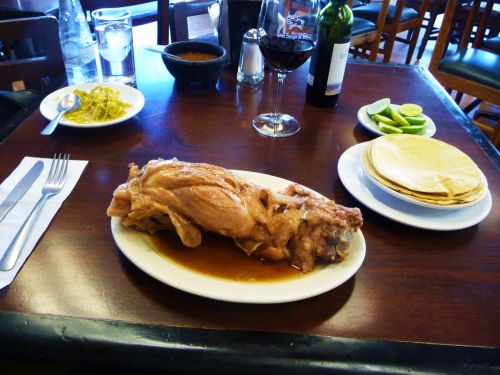
When I got to Mexico City all those years ago I was never very enthusiastic about eating a dish called chamorro, a pork shank so huge that when it is finished it looks like a lost dinosaur bone.  But then an advertising executive named Jorge Loaeza invited me to join him at a cantina called Bar El Sella, on Calle Dr. Balmis #210, a stone's throw from Avenida Cuauhtémoc and just a few steps into the Colonia Doctores. El Sella's version of chamorro (pictured above) is braised and steamed and so delicious that I am convinced it would convert any Jew or Muslim who took the trouble to eat it.

Other house specialties are variations of the tortilla española and parsely fried in bacon fat. It is around the corner from the Hospital General, so many of its patrons are doctors in their lab coats on their lunch hour. Last time I was at El Sella, I spied a table full of medical men, sharing a chamorro, a tortilla and a steak. Given their menu choices, I asked them if they were cardiologists. I'm afraid they didn't think I was very funny.


A hotel with a past

The Hotel Roosevelt, which abuts the Colonia Condesa on Avenida Insurgentes and Avenida Veracruz, opened its doors in  1938. Anecdotes about its past proliferate. Until the mid-1940s, there was a bullfight stadium located in walking distance. An arrangement was made in which the toreros were allowed to change into their bullfighting gear at the Roosevelt, and then march through the streets, parade-style, to the arena. Cubans swear that this is where Fidel and Che stayed while planning the revolution in the late 1950s. Actor Ignacio López Tarso recalled a friendly manager who allowed him to sleep on the roof in the 1950s, before he became a star of Mexican cinema.

By the early 1990s, the Roosevelt had acquired a seedy reputation. Some women who worked at a couple of notorious night spots in spitting distance, the Bar Jemma and Cherry's Bar, would take their clients to the hotel to exercise the world's oldest profession. Soon after, the clubs closed down and a new management took over. Rooms were renovated and the facade was changed (as was the hotel's reptuation). Over the summer, the facade was repainted -- how long will it remain that white? Today it is one of the very few modestly priced hotels in the area, a decidedly expensive neighborhood by Mexico City standards.

Stompin' at the Savoy


Prior to World War II, Mexico's greatest cultural influence came from France rather than the United States. In the early 20th century, many office buildings in the historic center of Mexico City were designed with commercial arcades that cut through the ground floor, an architectural innovation from the 1800s in Paris. Such arcades inspired an unfinished book of some thousand pages by Walter Benjamin, and were part of what inspired him to call Paris "the capital of the 19th century. "

This is one of the few such arcades that still survives downtown, on calle 16 de septiembre #6, almost at the corner of the Eje Central. Its offerings include a men's haberdashery, a cafe and, in the right-hand foreground, a branch of Mazapanes Toledo, which has prepared and sold marzipan candies since 1939.

In the back of the arcade is a movie theatre known as the Cine Savoy, which has been there since 1943. These days it caters to the sort of clientele, exclusively male, that tends to go to the cinema clad in raincoats, regardless of the weather. One of my favorite Mexican writers, J.M. Servín, has a chronicle about his visit to the Savoy in his delightful new book, D.F. Confidencial.

Making his bones

Jackson-etc-024

"La catrina" is the nickname name for the skeleton of a cadaver in Mexico, and I am not the first to notice that association between death in Mexico and "Katrina," the name of the hurricane that broke the levees in New Orleans. The well dressed gent above walked through the streets of the French Quarter Festival not long ago. But don't you think he would have been right at home in Mexico?

I get my favorite dish - fish

Marisqueria

Soon after I arrived in Mexico City I was tipped off that the freshest and least expensive way to eat seafood was at marisquerías, informal fish restaurants that are often attached to markets. Among their specialties are oysters on the half shell, a mixed seafood cocktail called vuelve a la vida (back to life), and mojarras (a kind of sea bream, either whole or fileted) in garlic sauce or in a Veracruz sauce of olives, tomatoes, onions and capers.

But perhaps the nicest thing about marisquerías is their shamelessly gaudy decoration. This photo was taken at one in the San Ángel market on Avenida Revolución.