For sale

June-30-011

Virtually every neighborhood in Mexico City has a tianguis, also known as a “market on wheels” – a once-a-week event in which vendors are sanctioned to invade and occupy several streets, where they set up stalls with metal poles and wooden planks under pink plastic tarpaulins. Mostly they sell fresh fruits and vegetables but there is also cooked food and all manner of tchotchkes: cookware, toys, clothes, blankets, and pirated CDs and DVDs.

In a typical tianguis there are two or three lanes of stalls, and the customers walk in the limited space in between. By noon, when shoppers have arrived en masse, movement can be painstakingly slow. Among the clients, merchants without stands sinuously circulate on foot, displaying their wares from boxes strapped around their shoulders like cigarette girls. In this fashion, a man with a black beret and a gray beard sells Argentine empanadas. Another announces sticky candies called muéganos in a growly singsong, while another, with slick hair and a pencil moustache, offers heads of garlic, a few fresh herbs, boxes of toothpicks and matches.

Like many of the tianguis merchants, this man is not above seduction, blackmail or guilt trips to induce people to buy his wares. He will begin by pointing out how large, round and fresh his heads of garlic are on that particular Sunday. If you tell him you still have garlic that you bought from him the previous week, he’ll say, “Don’t punish me. Buy some for your mother-in-law.” If you remind him that you are unmarried, he will sigh sigh and say, “I never intended to be here bothering nice people like you. I wish that I could have had an education, so I could be doing something more useful.”

Such tactics are common at the tianguis. There is a stand where a young man with a pompadour sells cantaloupes. If I ask for one melon, he is always quick to prod me to acquire another for my mother, wife, sister, mother-in-law, etc. At this point, I have told him I live alone frequently enough so that he now remembers, and instead suggests that I buy more melons for my girlfriends – real, imagined or potential – advising that an extra cantaloupe in the house could be a useful seduction technique, or even an aphrodisiac. If I insist that I only want one, he tells me he has eight children. (He is no older than 25.) Should I decide I want two, he will then whisper in my ear that he will sell me a third at half price. If I refuse to budge, he looks at me as if my limited melon consumption is a colossal disappointment, a broken promise.

-- excerpted from First Stop in the New World: Mexico City, The Capital of the 21st Century

The Chinese are coming

Chino-1

During the early twentieth century, the Chinese were one of the largest immigrant groups in Mexico, particularly in the North, where they had great success as merchants. Unfortunately, their accomplishment was followed by an anti-Chinese movement, which included racist legislation and even some incidents of riots, desecration of property, and jailing of Chinese for no reason. This monolithic timepiece, on Calle Bucareli in the Colonia Juarez in Mexico City, is known as "the Chinese clock." It is a replica of one that was given as a gift to the Mexican people by the Emperor of China in 1910, to commemorate the hundredth anniversary of the Mexican Revolution.  Anti-Chinese hooligans destroyed it in 1913. The replacement was set in its place in 1921.

Tang-Yuan

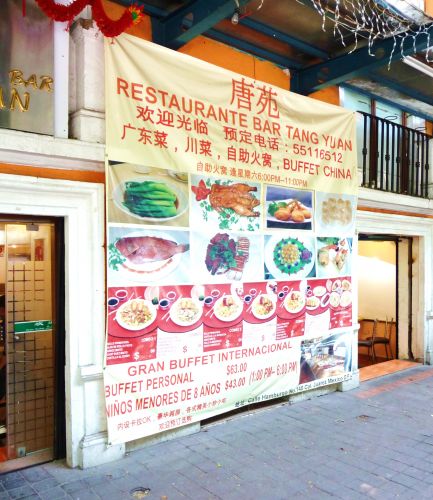
Jose Luis Bárcenas, the immigration lawyer who arranged all my paperwork in Mexico, tells me that in recent years, once again the Chinese are among the fastest-rising groups of immigrants in the city. The D.F.'s Chinatown is only one block long, but the Chinese are scattered throughout the entire city.

Isla

Their emergence has heralded a preponderance of restaurants featuring ultra-greasy Chinese buffets where, at your own peril you can serve yourself all you can eat for about sixty pesos (less than five dollars at the current exchange rate). These places are perhaps a form of revenge for the earlier anti-Chinese movement. Click here for an earlier post about the best Chinese restaurant in Mexico City.

Still more sign language

One-shoe4

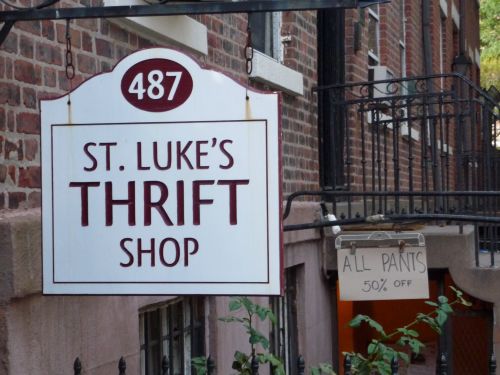
In New York, on Clinton Street, a stone’s throw from the Williamsburg Bridge, I saw this advertisement. According to the way the sign is phrased, doesn’t it appear that they will sell you one shoe and then, as a big favor, let you have the other half of the pair at a fifty per cent discount?

Pants-off1

Then I saw this other sign -- the one on the right. I grant you that it probably is a testament to my perverse imagination, but when I read it, I pictured someone with her pants halfway on and halfway off.

Spitting on white boys

P1020195

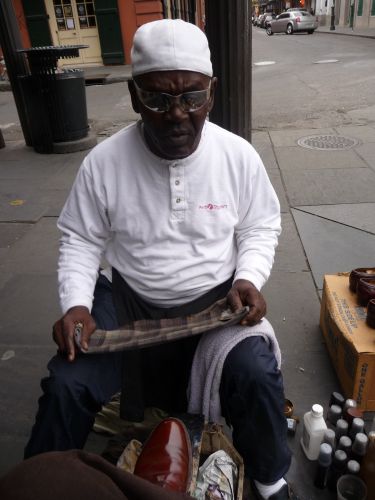
He calls himself "The Legend," and says he has been shining shoes on Jackson Square in the French Quarter for 32 years. He tends to attract customers with discreet remarks like, "Either you're going to come to me now or you're going to come to me later," or by shouting lines like, "Free beer, free shoeshines, free bullshit." He finishes with what is traditionally known as a "spit shine," in which he lets loose with a projectile of saliva onto the leather, which leaves the shoe -- as indicated here -- brilliantly shiny. "This is the only time I get to spit on white boys," he told me as he was completing the endeavor. "And they like it, too." Only the bullshit is free. The Legend charges six dollars per shine, and before the customer pays, he reminds him that "Tips is my middle name."

Bottoms up

Frida2

In the last year, I have passed through so many airports that I don't remember in which one I took this photograph. I was making my way to a connecting flight -- it was probably in Texas.

Of course her image has adorned refrigerator magnets, coffee mugs and the like for years. After all that, I don't know why this come-on for a cocktail struck me as particularly vulgar. Do you think she's spinning in her grave?