Still more sign language

One-shoe4

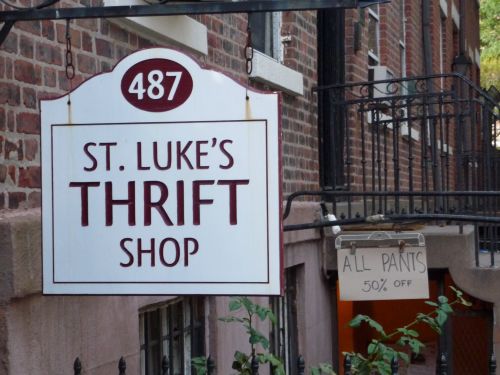
In New York, on Clinton Street, a stone’s throw from the Williamsburg Bridge, I saw this advertisement. According to the way the sign is phrased, doesn’t it appear that they will sell you one shoe and then, as a big favor, let you have the other half of the pair at a fifty per cent discount?

Pants-off1

Then I saw this other sign -- the one on the right. I grant you that it probably is a testament to my perverse imagination, but when I read it, I pictured someone with her pants halfway on and halfway off.

Spitting on white boys

P1020195

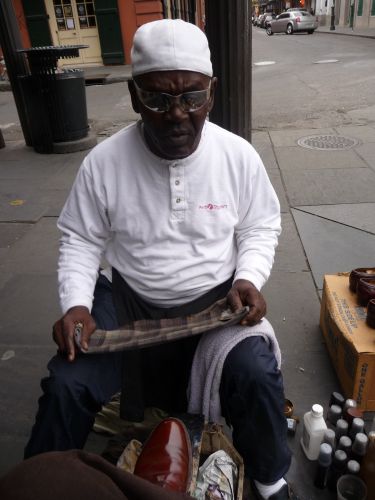
He calls himself "The Legend," and says he has been shining shoes on Jackson Square in the French Quarter for 32 years. He tends to attract customers with discreet remarks like, "Either you're going to come to me now or you're going to come to me later," or by shouting lines like, "Free beer, free shoeshines, free bullshit." He finishes with what is traditionally known as a "spit shine," in which he lets loose with a projectile of saliva onto the leather, which leaves the shoe -- as indicated here -- brilliantly shiny. "This is the only time I get to spit on white boys," he told me as he was completing the endeavor. "And they like it, too." Only the bullshit is free. The Legend charges six dollars per shine, and before the customer pays, he reminds him that "Tips is my middle name."

Bottoms up

Frida2

In the last year, I have passed through so many airports that I don't remember in which one I took this photograph. I was making my way to a connecting flight -- it was probably in Texas.

Of course her image has adorned refrigerator magnets, coffee mugs and the like for years. After all that, I don't know why this come-on for a cocktail struck me as particularly vulgar. Do you think she's spinning in her grave?

Goodnight sweet prince

orange-sky

Phil Kelly died on Monday. An Irishman who arrived in Mexico City in the early 1980s, he looked at the city assiduously, and through sheer powers of observation, made it his own. No one who wrote about Mexico City influenced me as much as Phil's painting did. I venture to guess that if I had never met Phil, I may never have written my books about Mexico. In my book Las llaves de la ciudad, there is a long profile about him. Here is a link to an earlier post about him.

Apart from being a brilliant painter, Phil read in three languages, and had a huge store of literary references in the recesses of his brain. There is a dish served in Mexico called chamorro. It's pork shank -- basically the whole calf on the bone. Once, we were in a cantina and I ordered the chamorro. When it arrived, it was enormous, a huge piece of meat. Phil looked at it and said, "Chamorro and chamorro and chamorro."

Many of us will miss him.

Happy hour in the homicide capital of the world

Downtown-Juarez

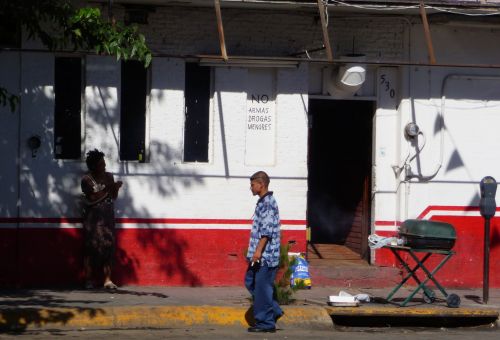
Recently my mitigation work took me to Ciudad Juárez. In the last few years, the news from this city, just across the border from El Paso, has eclipsed its rich libertine history. Throughout the 20th century, both well-to-do Mexicans and night-tripping tourists enjoyed clandestine sex, inexpensive booze, as well as other undercover intoxicants in this town. It is hard to believe, but not long ago stars such as Frank Sinatra and Louis Armstrong entertained at the now-defunct Fiesta night club downtown.
Downtown-Juarez-7

Today, of course, Juárez has distinguished itself as having more murders than any other city in the world, including war zones.

Muertas-2

In the mid to late 1990s, the brutal killings of hundreds of women, mostly young factory workers, made international headlines. The cross at the bridge which takes you to Texas is in their memory.
Red-light-1

In the last two or three years, much of President Calderón’s failed war on drugs has been played out in Juárez, where literally thousands have been killed. Many of the murder victims have been police and soldiers, and some have been drug traffickers. Unfortunately a huge number of the casualties have been among people whose involvement in the trade is penny ante, or people who have had the bad luck to be tangentially associated with such people.
Red-light-5

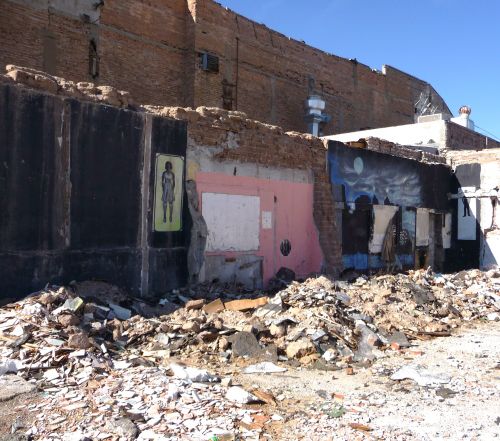
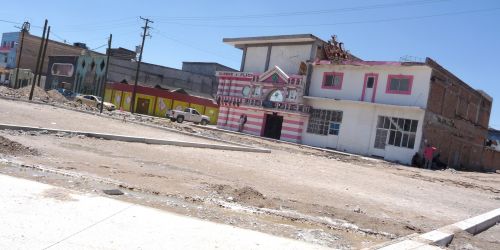
The red-light district has been almost completely demolished, to make way for a proposed shopping mall.

Kentucky-2

I went to Avenida Juárez, the traditional honky tonk strip, one late afternoon. There weren’t many people out. The bars were mostly deserted, except for a few stragglers at the Club Kentucky, in business since 1920. They say that at one point or another, “everyone” had a drink here – from Liz Taylor and Richard Burton, to John Wayne, Steve McQueen, Bob Dylan, Marilyn Monroe and the Gipper himself, Ronald Reagan.

Downtown-Juarez-5

I was in Juárez from a Saturday to a Tuesday. The headline in Monday’s tabloid was that in the previous three days, forty-two people had been murdered.

Downtown-Juarez-6

After the North American Free Trade Agreement was passed in 1994, a huge number of assembly factories were built in Juárez, creating steady if poorly paid employment for thousands of Mexicans. Most of them manufactured products for consumption in the U.S. Since the U.S. economy tanked two years ago, many of these factories have shut down or drastically reduced personnel.

Downtown-Juarez-9

Some estimates say that about a half a million people have fled the city in the last couple of years. It is more and more difficult for Juárez’s citizens to make ends meet, which is one reason many have taken to petty drug dealing. A lot of them are ending up dead. I don’t pretend to have the answer to the problem. But for practical purposes I’d like to see drugs legalized. After Prohibition was repealed, people stopped killing each other over barrels of whiskey.