Believe the hype

pujol

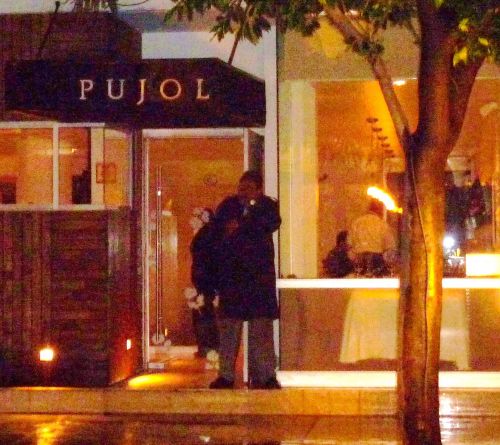
In First Stop in the New World, in a chapter about eating in Mexico City, I wrote that the best food here is found in stalls on the sidewalk, in markets and cantinas. I still stand behind that statement, although there are exceptions. One of them is Pujol, my favorite white-tablecloth restaurant in town. The young chef, Enrique Olvera, has been written up in food magazines around the world; in my opinion, justifiably so.

For the tenth anniversary of Pujol, Olvera has published a book which includes 100 recipes and various essays, including one by yours truly. For information about how to obtain it, click onto his website and call the restaurant.

The chef tends to dissect and deconstruct time-honored Mexican dishes. For instance, his version of mole de olla -- a traditional soup with meat and vegetables -- is served dry on a plate, its ingredients grilled, sauteed and separated from each other. Squash flowers, instead of being stuffed inside a quesadilla, are served hot and liquefied in a glass, topped with a creamy foam and cinnamon, as "capuccino."

His robalito al pastor is a fancy version of a taco you can find on nearly any street corner for five pesos. The Pujol version is, of course, considerably more expensive. Olvera uses sea bass instead of pork, cured with chile, orange juice, garlic and annato, embellished with a pineapple flavored buerre blanc, and cilantro, chile and lemon ground together in a molcajete.

If you have the money to blow on one expensive meal while you are in Mexico City, this is the place to go. It's at calle Francisco Petrarca, 254, in Polanco.

In the photo above, a bodyguard whose charge is dining inside the restaurant is reticent before the camera.


Dirty bird?

Boid-3

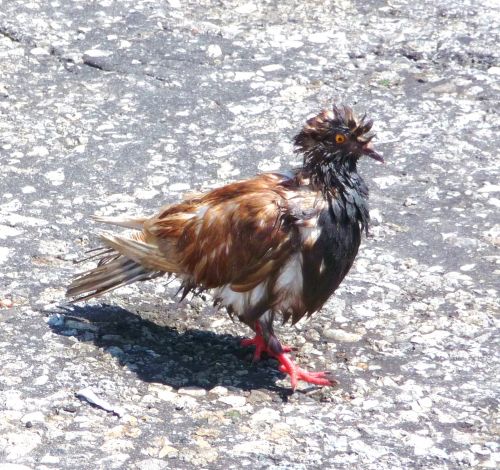
I saw this critter near my apartment in New Orleans, unable to fly, hobbling along the corner of St. Claude and St. Roch. I just assumed he was a victim of the oil spill. Friends of mine protested: BP has nothing to do with this fellow; he's just a pigeon who got into a street scrap. What do you think?

Stories behind a market

abelardo-3

Opened in 1935, the Abelardo Rodríguez market is named after a nearly-forgotten man who served as president of Mexico for two years (and was really a puppet for Plutarco Elías Calles, a former president who remained the power behind the throne).

What little I know about Rodríguez sounds like the stuff of a novel. From the northern state of Sonora, he did not even finish primary school. He worked as a miner, in a hardware store, and as a baseball player before joining up with the Mexican Revolution. His most significant legacy was to lengthen the presidential term from four to six years, even though two were plenty for him.

The market, in the centro on the corner of calles Venezuela and Rodríguez Puebla, is one of the few left in Mexico City that was built before World War II. Some of its walls and ceilings are decorated with Socialist themed murals painted by various young artists who studied under Diego Rivera, including Antonio Pujol, Pablo O'Higgins, Marion Greenwood and Isamu Noguchi.

Noguchi had already established himself in New York and Paris before coming to Mexico, and while working with Rivera, would have a passionate affair with Rivera's wife, Frida Kahlo. His mural is on the upper floor of the market, which was closed at my last visit. Sadly, all the art work has decayed with the passage of the decades, but a process of restoration is in progress.