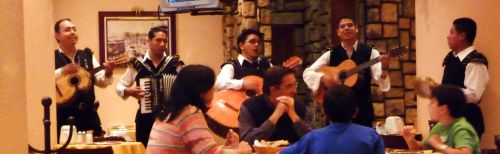
Groups of wandering minstrels known as estudiantinas go back to the first universities in Spain, in the late 12th century. They were bands of impoverished students who, to survive, would play music in the streets and pass the hat afterwards. You still find them in Mexico City, particularly on weekends, roaming through the restaurants of the centro histórico. They will typically stay in each eatery and play several numbers. As they are groups of six or more musicians, their warbling, strumming and unbearably unstinting cheer invariably drown out the conversation at your table. As such, talk must be suspended until they leave. Call me a grouch, but I never give them money -- I don't want to encourage them. After more than 800 years, I believe it is time to designate the estudiantiana to its rightful place in history, and banish it to the scrap heap.
My other city
Some readers know I am from New York but have called Mexico City my home since 1990. The other important axis of my geography is New Orleans. It is the place to which I left home when I was 17 years old -- the first place I actually chose to live in. The least American of U.S. cities, it is often compared to a Caribbean island, a Mediterranean locale, or the northernmost African outpost. Comparisons are odious and New Orleans is unique. Last month I rented an apartment there and for the moment am dividing my time between it and Mexico City.
Perhaps it speaks ill of me that I believe one of the two hallmarks of a civilized city is the possibility of getting a drink until very late at night. In New Orleans there are bars that are open twenty-four hours a day. It is also legal to carry your drink in the street from one bar to another, so long as it is in a plastic "go cup" (glass or tin cans get you into beaucoup trouble).
(For the record, my other hallmark of a civilized city is a well-functioning public transportation system. Let's not even talk about the disastrous one in New Orleans -- yet. Suffice it to say that Mexico City's is like Paris or London in comparison.)
Corner bars like the Mayfair at 1505 Amelia Street, around the bend from the Columns Hotel, give the city a great part of its identity. Christmas decorations are lit all year round. Drinks are inexpensive and they have an excellent juke box. I cannot guarantee that the minute you walk through the door you will be treated as if you were a regular, but Miss Gertie, the owner, certainly made me feel like family the afternoon this photo was taken.
Thursday night fever
If as many people -- myself included -- who profess to have frequented the restaurant Covadonga five or ten years ago, before it became fashionable, were actually telling the truth, it never would have gone out of style. But in fact, in the late 1990s and early 2000s, it was precisely the sort of place, enormous and empty, that you could go to if you had reasons to make sure you didn't run into anyone that you knew.
That has all changed in the last few years. Covadonga -- an old-school Spanish restaurant with a cantina on the ground floor and a white-tablecloth dining room upstairs -- was consecrated by artists and gallery owners, writers, editors, journalists, and media personalities of dubious talents, and the sort of hangers-on who like to be seen in their company (or to at least bask in their tepid glow). On Thursday nights, when for those groups attendance is mandatory, it is so crowded that it is like having a drink on the metro during rush hour.
If you go to Covadonga for lunch, when there are not so many people there, not only is the service much better, but it is actually a more pleasing experience, with the sun streaming in from enormous picture windows, rather than the hideous fluorescent light with which it is illuminated in the evenings. It is on calle Puebla between calles Orizaba and Cordova in the Colonia Roma.
'Piano' Man
A recent convert to the discreet charms of Mexico City is the composer Michael Nyman, who bought an Art Deco home in the Colonia Roma. He divides his time between here and his native London, a city he professes to be sick of. Despite limited knowledge of Spanish, he has already arranged to do concerts, write film scores and the accompaniment to performance pieces in Mexico. Nyman wrote the music to various Peter Greenaway films, but his most well-known score is for the film The Piano, with Holly Hunter and Harvey Keitel. (The CD of that movie sold about four million copies.) Here is the maestro, resting at an antique store on Calle Campeche, from which he has decorated much of his home.
Viva Mauricio
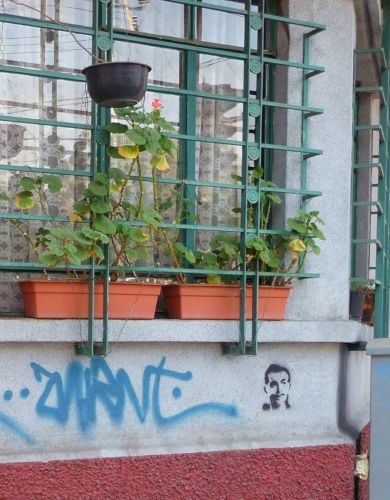
Immaculately dressed, every salt-and-pepper hair in place, sporting a Clark Gable moustache, Mauricio Garcés starred in a series of saucy comedies in the 60s and 70s, in the role of a mature and world-weary seducer, famous for lines of dialogue like "Debe ser horrible tenerme y después perderme" (It must be horrible to have me and then lose me) and "Dios sabe que tengo miles de razones por ser vanidoso" (God knows I have thousands of reasons to be vain). He died in 1989, but in the hearts of many lives on: Recently I saw this stencil of him on a wall in the Colonia Del Valle.