James Bond's hotel

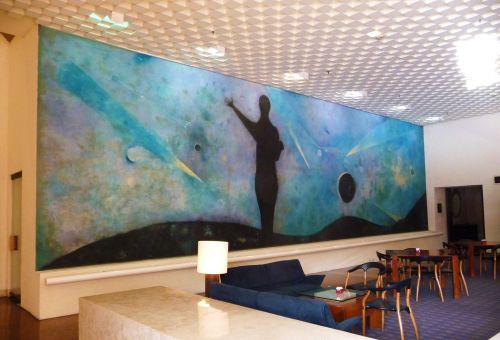
tamayo

When people ask me for hotel recommendations in Mexico City, they are usually looking for budget options, but if money is no object I steer them to the Camino Real on Avenida Mariano Escobedo in the Colonia Anzures. Opened in 1968, it was designed by architect Ricardo Legorreta in the form of a pyramid, evoking pre-Hispanic Mexico. Yet many of the design elements, including bright yellow and pink paint, are very much of the period. Indeed, while walking through its halls, or sitting in the lobby bar (with a clear plastic floor, and water underneath), I feel like an extra in a James Bond movie.

Even if you aren't looking for a place to stay, or cannot afford the Camino Real, you might want to have a drink in that bar. Or better yet, a coffee in the cafe, where you can ponder this Rufino Tamayo painting.
Sweaty tacos

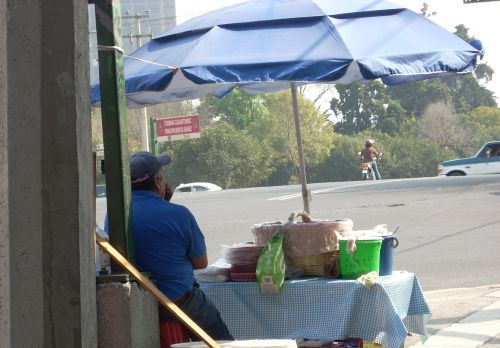
puesto1

It is the dream of every unskilled Mexican with no connections to establish a business selling food. Particularly profitable are stands on the street, because they require minimal investment and their owners are duty-bound to pay few taxes. Some don’t pay any at all.

The least adorned points of sale are those which dispense tacos sudados – sweaty tacos, so-called because after being fried in the morning, they sit steaming in a basket during the day until their vendors sell out. (They are also known as tacos de canasta, or tacos in a basket.) Most commonly stuffed with potatoes, beans, fried pork rinds or green mole, they are delicious and extremely cheap – usually 3.5 pesos, or about 23 cents U.S. at the current exchange rate.

Juan Monsalvo, the fellow who from whom I most commonly buy tacos sudados, reeks of humility. Missing a couple of front teeth, he is impeccably well-mannered and always speaks to his customers using the polite form of address. I once asked him how many tacos he sells a day. He said that on a good day he will sell out his ration of 250. At 3.50 pesos each, that represents gross earnings of over $50 US.

But then he told me that he gets up at four o’clock each morning and makes 2000 tacos. A phalanx of salesmen buy the rest from him at a peso each and vend them on their own streetcorners. His workday lasts twelve hours. Math is not my strong point, but I believe he makes more money than I do.

Department of self-congratulation

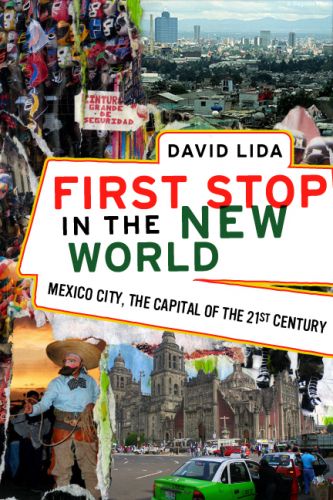
When you write a book, you never know what's going to happen. Sadly, most of them disappear into black holes, never to be heard from again. I am relieved that the critical response to First Stop in the New World, my panoramic look at Mexico City, published last June by Riverhead, was so overwhelmingly positive. (Click here to get to its Amazon page and read fragments of the reviews.)

first-stop-cover

There were more surprises at the end of last year. It was named one of the best fifty non-fiction books of the year by the San Francisco Chronicle (click here) and one of the ten best books of the year by an internet site called The Globalist (click here).

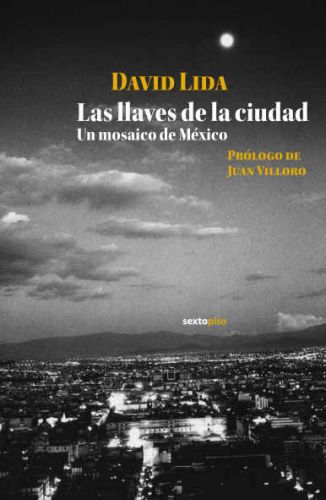
cover-llaves

My other book, Las llaves de la ciudad -- a collection of magazine pieces about some of Mexico City's most extraordinary citizens -- was named one of the 12 best books of the year by Críticas, a magazine that reviews books in Spanish in the U.S. (Click here.) It is in bookstores all over Mexico. After a long delay, it is finally available on Amazon (click here), at Barnes & Noble (click here) and at Borders (click here).

Blue over the blue law

martell


Earlier this month, the geniuses at the city’s Legislative Assembly passed a decree by which any establishment that dispenses alcohol must serve its last drink by 2:30 a.m. and close its doors by 3:00. For many reasons, I am dismayed. For one thing, Mexico City has a rich libertine history, and it seems a shame that current conservative politicians can, without any sort of referendum, simply erase or paper over that past. Secondly, I don’t like “nanny” governments that presume their citizens are big babies unable to control ourselves or make adult judgments. (It strikes me as unseemly that, at my age, someone else should be deciding at what hour of the day I have my last drink.) What's more, hardworking waiters and bartenders will see their incomes diminished from the absence of those late-night, last-minute drunks who leave extravagant tips.

Finally – what is the point? I believe the law was passed mostly to comfort the wealthy parents of adolescent spawn, who often stay out too late, drink too much and crash their cars. If parents cannot control their children, they shouldn’t look to the government to do the job for them. These kids can likely find somewhere to drink past three in the morning, even if it isn’t a public place, and get into smashups anyway.

Amanda

amanda-7

She was by far my laziest student. She had long eyelashes; lank, dark hair, and a huge, slack and provocative mouth. These qualities, combined with the fact that she only stood about four feet tall, gave her the look of a sexually precocious, perverse baby.

She took workshops in creative writing with me at the Escuela Dinámica de Escritores. Yet when the day came to hand in assignments, most of the time, she wouldn’t bother to show up. Once, she gave me her homework, and it was all of one sentence. “This is fine, Amanda,” I said, trying to encourage her. “But it would be nice to see the sentence that comes after, and the one that comes after that.” Her response was nothing more than an insolent look, as if I were truly clueless.

A year or two after classes were over, she resurfaced as “Amandititita,” something of a novelty act in the Mexico City pop music firmament. She has cut a couple of CDs and been covered widely by the press. Not long ago I read an interview in which she complained about how many commitments she has – as a pop sensation, her time is no longer her own. Click here to see a video of her biggest hit, in which she sings about the travails of having a metrosexual boyfriend.