Never let them see you sweat

gym

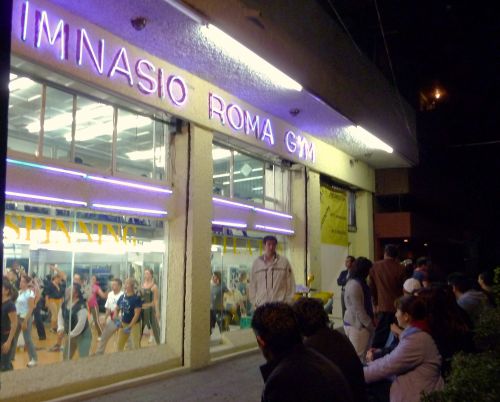
The Roma Gym on Calle Orizaba, in the Colonia Roma between Calles Álvaro Obregón and Chihuahua, has picture windows that face the street. For years, the early-evening aerobics classes have attracted an audience of mirones – voyeuristic onlookers. For those who are merely watching, or those who want to replace the lost calories after exercising, the gym is located a few doors down from La Bella Italia, Mexico City’s best ice-cream parlor.

Hurdy-gurdy

hurdy-gurdy

Last week I posted about the sweet potato salesmen who announce their presence on the street with a shrill steam whistle, the same way they did in the 19th century. Another anachronistic apparition on the streets here, principally in the centro histórico, are various men and women in beige uniforms, who tend to work in pairs. One hand-cranks a hurdy-gurdy while the other seeks alms in an extended cap. (You can see this fellow's partner reflected in the plate-glass window.)


I used to believe that these machines were brought to Mexico during the invasion of the Hapsburgs in the 1860s, during the two or three years that Maximilian was emperor. But I subsequently learned that they came at a later date, around the end of the 19th century, as part and parcel of a substantial German immigration. Called Harmoni-Pans, they were manufactured by Frati & Co. in Berlin.


trati-co


I was told that there was only one man in Mexico City that knows how to tune the instruments. However, when I worked as an editor at a city magazine, I sent two reporters to find him, and neither could. Given how out-of-tune most of the hurdy-gurdys are, I imagined that the people who operate them couldn't find him either. 


A friend of mine, the novelist Gonzalo Soltero (see a link to his blog on the list of friends to the right) tells me that there indeed was only one hurdy-gurdy tuner in the city, a Chilean -- but he died. So if you know how these things work, come on over. You job is guaranteed.


Those interested in learning more about the lives of the hurdy-gurdy men can look for a book called La vida de los organilleros, tradición que se pierde, written by Victor Inzúa and published by Dirección General de Culturas Popularese e Indígenas.

Go gringos!

Torneo Peolimpico Varonil 2008

Those who have read "Winners," the chapter in my book First Stop in the New World about soccer fans in Mexico City, understand that I basically know nothing about the sport, and could hardly care less, which makes me quite the anomaly here. Last Wednesday night at about 8 pm, I got into a taxi and, as I often do, asked the driver how life was treating him.

"De la chingada," he said, which could be loosely translated as ... let's just say I'm sparing the children here, if any of them read this blog.

"Why?" I asked. "What's the matter?"

"We lost against the United States," he said. "Two to nothing." It had been a qualifying match for next year's World Cup.

I feigned surprise. "How could that happen?" I asked. "Aren't the Mexicans much better players than the gringos?"

"You're from Europe, right?" he asked.

"Yes," I said. "I'm French." Immediately I started to release the letter "R" from the back of my throat, and stress the last syllables of most words. (I wasn't trying to be a smartass. Mexicans tend to take soccer very seriously, even moreso when the U.S. is involved. I didn't want him to make me get out and walk if he found out I was a gringo.)

However, he went into a rant that had nothing to do with the gringos. Instead he complained about how badly the Mexicans play; about how there are too many foreigners on the national team; about how Sven-Goran Eriksson, the team's Nordic coach, doesn't know what he is doing; about the absence of teamwork among the players.

The driver, in fact, said that the U.S. was playing better than ever. Perhaps because he had a "Frenchman" in his taxi, he added that this was because there are so many Europeans on the team. He waxed rhapsodic about Zidaine.

He sighed and said what they always say around here when Mexico screws up a game: "We played like never before and lost like we always do."
The only martini in Mexico City

sa-2


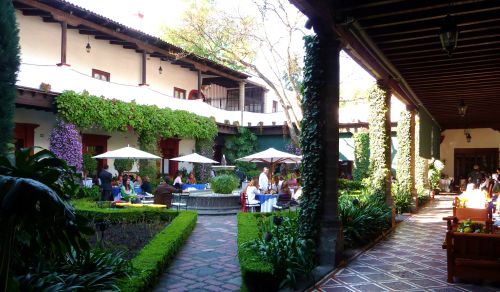
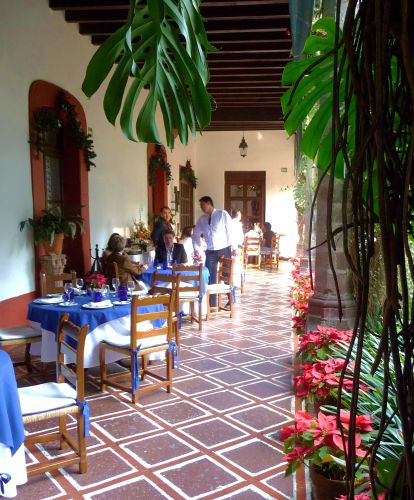
Although I wouldn’t go out of my way to dine at the San Ángel Inn, the patio of the restaurant is one of the loveliest places to have a drink in the world – at least in the parts of the world I have visited. It is located in an ex-hacienda from the late 18th century, and when the weather is warm, sitting there among the hummingbirds and bougainvillea is enchanting.


 january-5-005


People who drink margaritas swear by the San Angel Inn’s version of them. (I try to avoid them because sweet drinks are deceptive – they go to my head before I notice.)


 january-5-010


I like martinis but tend to be impossibly picky about them. The San Ángel Inn is the only bar in Mexico City where I will drink one. Or two. (The city is crowded with trendy joints that make chocolate, vanilla and strawberry martinis. That these drinks are called “martinis” at all strikes me as sacrilege.)


 sa-1


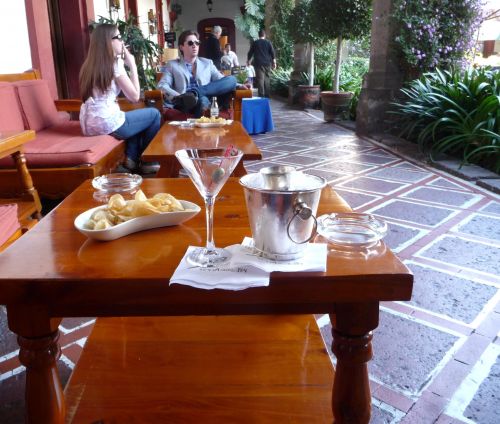
Aside from knowing how to mix them, the best thing about the martinis here is their presentation – in miniature silver pitchers within miniature silver ice buckets. This is not just an aesthetic consideration. The ice assures that they are freezing cold, and temperature is the most important thing about a martini. The potato chips served alongside are made at the restaurant. Drinking doesn't get much better than this.

Can it

William Booth, who covers Mexico for the Washington Post, recently contacted me and asked if I would be willing to talk trash with him. He was preparing a story about garbage in Mexico City. The amusing and informative results can be found if you click here.

I told him that when foreigners arrive in the city, one of the first idiosyncrasies we observe is how few trash cans there are. I have walked for what feels like forever with a used Kleenex or toothpick in my hand, fruitlessly searching for a place in which to get rid of it. I have taken to putting them in my pockets until I get home.

garbage-1

However, Booth told me about a pilot project in which 1,200 trash cans had been installed on the streets of the Centro Histórico. I told him I was skeptical of such a high number. But a couple of days later, while walking in that neighborhood, I noticed that there were suddenly as many as three garbage cans on a single side of a street.

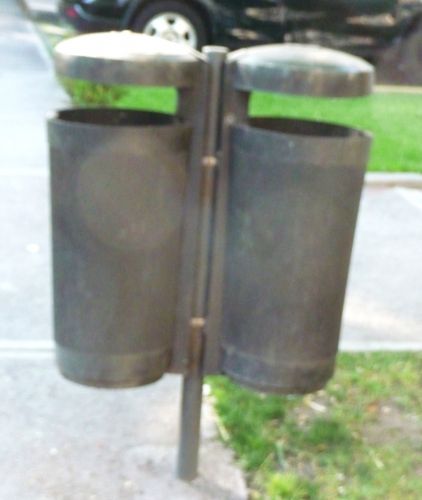
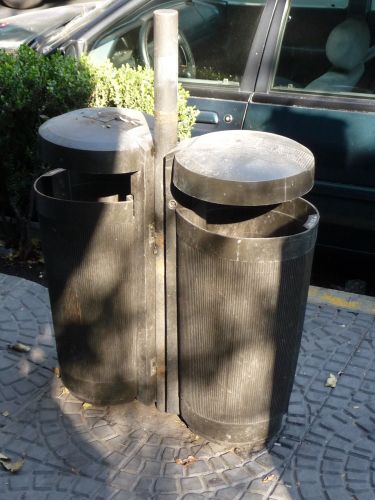
Then I realized that they are popping up in other neighborhoods as well -- in well-to-do areas, in any case. They look like the photo above – double-barreled, for organic and inorganic materials. (Sorry for the poor quality of the image.)

garbage-2

Some of them, like this one, seem to have been installed improperly and have slipped from their moorings.

garbage-3

In other parts of the city, old-fashioned mores still flourish.