Can it

William Booth, who covers Mexico for the Washington Post, recently contacted me and asked if I would be willing to talk trash with him. He was preparing a story about garbage in Mexico City. The amusing and informative results can be found if you click here.

I told him that when foreigners arrive in the city, one of the first idiosyncrasies we observe is how few trash cans there are. I have walked for what feels like forever with a used Kleenex or toothpick in my hand, fruitlessly searching for a place in which to get rid of it. I have taken to putting them in my pockets until I get home.
garbage-1

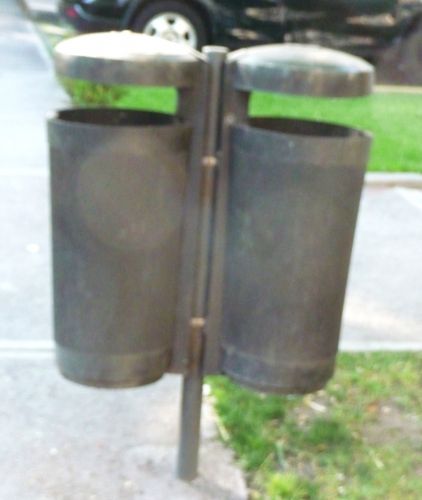
However, Booth told me about a pilot project in which 1,200 trash cans had been installed on the streets of the Centro Histórico. I told him I was skeptical of such a high number. But a couple of days later, while walking in that neighborhood, I noticed that there were suddenly as many as three garbage cans on a single side of a street.

Then I realized that they are popping up in other neighborhoods as well -- in well-to-do areas, in any case. They look like the photo above – double-barreled, for organic and inorganic materials. (Sorry for the poor quality of the image.)
garbage-2

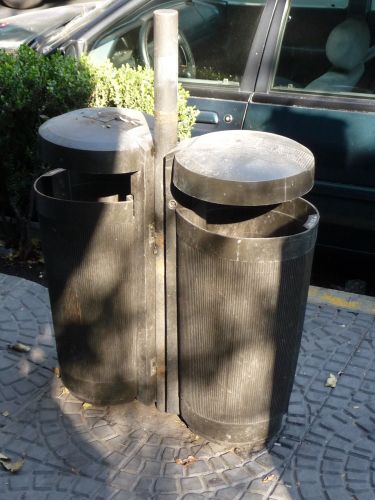
Some of them, like this one, seem to have been installed improperly and have slipped from their moorings.
garbage-3

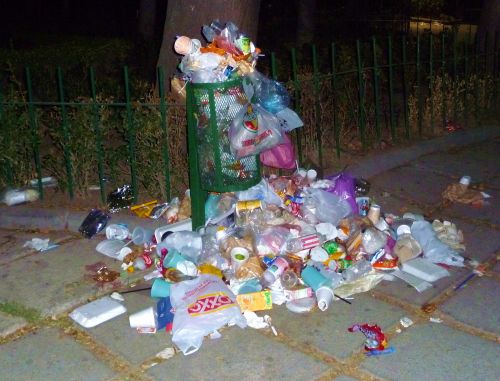
In other parts of the city, old-fashioned mores still flourish.
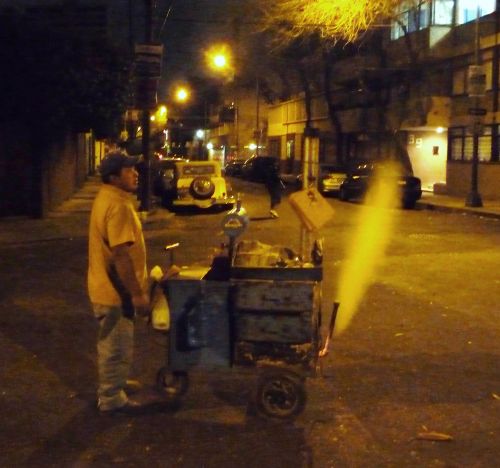
Sweet potato

camote


Some people in Mexico City – mostly European immigrants – from time to time twist their mouths into a Gallic moue and complain about how this place has become agringada – “gringofied,” or Americanized. Without a doubt, in well to do neighborhoods Starbucks has become ubiquitous, and Wal Mart Mexico is now the largest private employee in the country. There are also the predictable outposts of McDonald’s, Burger King, and most omnipresently, KFC. In ritzy areas, shopping malls, of the mega and strip variety, are becoming ever-present.


However, despite these perhaps inevitable indicators of “progress,” Mexico City remains an emphatically Mexican city. Each evening, an hour or two after sunset, I hear a shrill steam whistle that tips me off that a vendor of baked sweet potatoes is passing by. He will sell them plain (the way I like them), or dress them with condensed milk, sugar and/or honey. Another whistle lets me know that the knife sharpener is on the block. The gas man cries out when he passes by, as does the guy who repairs curtains and the other who buys old newspapers. This is the way business was transacted centuries ago, and has nothing to do with the contemporary U.S. I wonder where the Europeans are when all these guys appear.

Irony

capital

In the last few years, the brightest minds of the government of Mexico City decided to give the metropolis a motto. They chose Capital en Movimiento (Capital in Motion), although never explained just what that was supposed to mean. This buzzing bright sign with the blazing slogan is located on one of the inner-city freeways in the north of town. The photo was taken during rush hour, at about six in the evening, when traffic is so dense that "motion" is per centimenter.

A post for the Year of the Ox

chinatown-2


Mexico City’s Chinatown, on Calle Dolores between Calles Independencia and Artículo 123, is all of one block long. I have eaten at several of the street’s restaurants, and the food was … edible. I practically grew up in New York’s Chinatown, so after moving here, missed Chinese food with great longing and nostalgia.


ka-1


It took years, but I finally found an excellent Chinese restaurant in Mexico City. This is the signpost for Ka Won Seng. It is located at Calle Albino García #362, at the corner of Avenida Santa Anita in the Colonia Viaducto Piedad, not far from the Viaducto metro station.


ka-2


Here, many of the customers are Chinese, who sit in groups of eight or ten at circular tables with Lazy Susans in the middle, gorging on a corresponding number of dishes. Among my favorites are the roast duck, the Singapore noodles, a spicy hot pot with tofu and eggplant, and the steamed pompano with ginger, scallions and soy sauce.


ka-3


Unearthing this place is a story of blind luck. One afternoon I was in a taxi, stuck in traffic, and made conversation with the driver. He mentioned in passing that his sister had married a Chinese immigrant. I told him how much I loved Chinese food and how I hadn’t found a restaurant I liked in Mexico City. He suggested I go to Ka Won Seng – or at least I think he did, because he remembered neither the name nor the address of the place. He was only able to give me a vague idea of where it was located. I scoured the neighborhood on foot for an hour or two until I stumbled upon it.


ka-5


In Mexico City -- as well as other parts of the country -- citizens are more accustomed to having what they think is Chinese food (chop suey and the like) in what are known as cafés de chinos (Chinese cafes). Some of these places date back to the 1920s, and were opened by Chinese who came to Mexico to build the railroads and stayed on. They tend to serve coffee, sweet rolls and enchiladas suizas as well as sloppy versions of ersatz Chinese cuisine. This sign, in the door of Ka Won Seng, warns all who would enter that there are no sweet rolls, coffee, or Mexican food available across its portals.


Chicken King, part three

gregg-lucas1

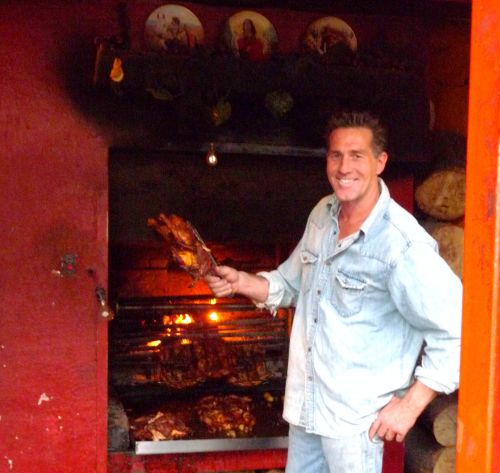
In the past 25 years or so, while on the job, Gregg Lucas has broken four ribs, both hands, both legs, dislocated his left shoulder and hurt his back so badly that he needed to wear a neck brace for eight months. Nevertheless, he says he loves his work – he’s an actor, model and stunt man – so much that he would never think of leaving show business.


Perhaps, however, he was thinking of hedging his bets when a couple of years ago he bought PIN Pollos, a chicken shack in the Colonia Roma on Calle Campeche, almost at the corner of Monterrey. The birds are marinated and grilled over a wood fire. You can have them delivered to your home if you live in the area, by calling 5574 6349. Sometimes the actor will bring them to your doorstep himself.


Lucas grew up in the U.S. but has lived in Mexico for the last 15 years. Here, he has modeled for Eagle Eye sunglasses, a brand of milk marketed to people over 40, and has even been the Marlboro Man. He’s appeared in various Mexican soap operas, and was “the first guy to get killed” in Matador, a Pierce Brosnan vehicle that was shot here.


He hopes to combine his two professions at some point. “I have an idea for a TV commercial,” he says, “where, to deliver a chicken, I get on a motorcycle, then a paraglide, then a jeep and finally on a horse.”