Nothing to hide

july-31-048


Last time I checked there were 80,000 police to protect the eight million residents of the Federal District. (El D.F. is only the central part of greater Mexico City, with its population of 20 million.) There may be more cops today; before he was elected mayor two years ago, one of Marcelo Ebrard’s campaign promises was to increase their number to 100,000.


This is an off-the-charts per-capita ratio compared to other big cities. According to a New York Times report in September of 2006, nine thousand police officers were enough to protect the four million residents of Los Angeles, and New York made do with 37,000 for eight million citizens.


Mexico City cops come in a dizzying variety: preventive police, investigative police, transit police, tourist police, mounted police, auxiliary police, bank police, diplomatic police, industrial police and customs police, among others, each corps with its own uniform.


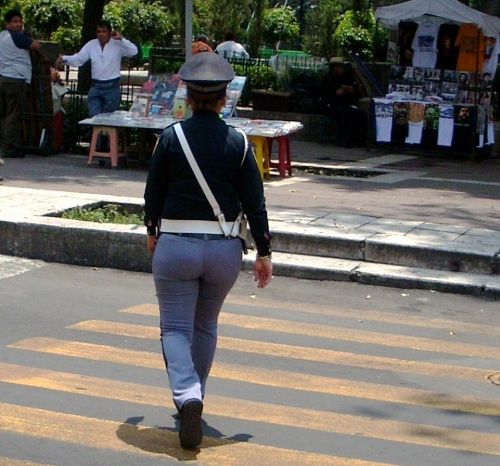
In the last decade or two, the police department stepped up efforts to hire more women. Mexico City law enforcement is legendarily corrupt, and apparently, the logic was that females are less prone to bribery and other commonplace forms of malfeasance (a notion that tends to be laughed at by Mexican males).


One thing is certain – policewomen are given uniforms with pants so tight that, regardless of whatever infractions of which they might be guilty, they would never be able to get away with smuggling.
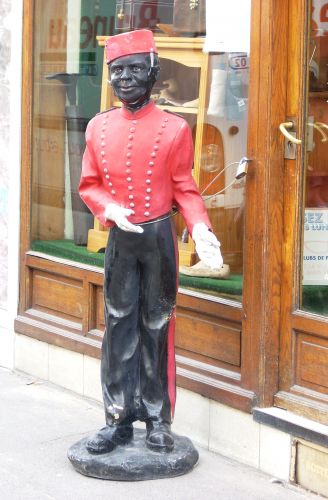
Another endearing “negrito”

tete-de-negre


My post of July 31 about the words and phrases that Mexicans use to refer to people from countries and ethnic groups aside from their own inspired more comments than any other that I had previously published. More than a dozen people contributed their thoughts.


For some perspective, I thought it only fair to exhibit this photo of a statue outside of a shoe repair shop in Paris. It is located around the corner from the Cambronne metro station (and the apartment where I stayed for a few days last September).


I visited Paris for the first time in the early 1980s. In every pastry shop, there were round, ball-shaped cakes, covered in chocolate, on trays with the enticing legend, “Tete de negre.” In French, tete means head, and negre is the aggressive word for a black person, equivalent to the reviled n word in English (as opposed to noir, which literally means black and is the more politically correct form of expression).


Usually, when I brought up “tete de negre” to a French person, he would become flustered and impatient with me, and make a disparaging remark about people from the United States, and our obsession with being politically correct. Yet last autumn in Paris – the first time I had visited France in five years – I noticed that the bakeries were no longer selling tetes des negres. The pastries had at some point been reassigned much blander names, such as boule de chocolat (chocolate ball).


The black bellboy in the photo, however, presumably knows his place and has stayed put.

Chicken King, part one

july-31-054

The Colonia Condesa is the most resolutely trendy neighborhood in Mexico City, with its boutiques for twenty-somethings who have the slender bodies that can support jeans imported from Argentina, myriad restaurants with “fusion” cuisine, three Starbucks, wine bars and so forth. However, in this neighborhood you will also find the resolutely old-fashioned restaurant Tio Luis, which has been in continuous service since 1939 on the quiet corner of Cuautla and Montes de Oca.


For about 60 years, the proprietor of Tio Luis was Pedro Yllana, who had been a bullfighter in his youth, and as such the restaurant is decorated with posters and photos of la fiesta brava. (Unfortunately, Yllana passed away a few years ago. He was well into his 90s and now his heirs run the place.)


The menu at Tio Luis is eclectic, from enchiladas to paella to milanesa Holstein (a breaded cutlet with a fried egg and an anchovy on top). However, the place's nickname is el rey del pollo – the chicken king. Of the varied chicken dishes on the menu, the standout is Pollo Tio Luis (pictured above). It is the closest approximation to authentic Southern fried chicken that you can find in Mexico City.


Summertime and the living is easy


In Mexico City, it rains in the summer. Once in a while the rain lasts all day and it gets rather cold (at least by the standards of the temperate climate here). But usually it only rains for an hour or so in the afternoon (some days it doesn’t rain at all) and the weather is marvelous. Here are some signs that summer is here.


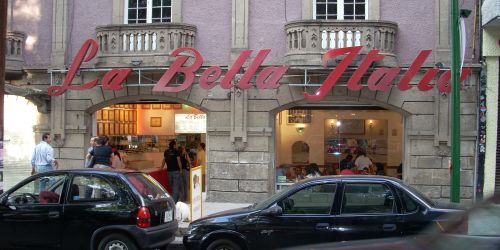
Bella Italia


La Bella Italia, which serves the best ice cream in the city, is packed. It’s on Calle Orizaba, just south of Álvaro Obregón, in the Colonia Roma.


kid


Here’s a kid on his summer job, directing traffic around a construction site. How old do you think he is?


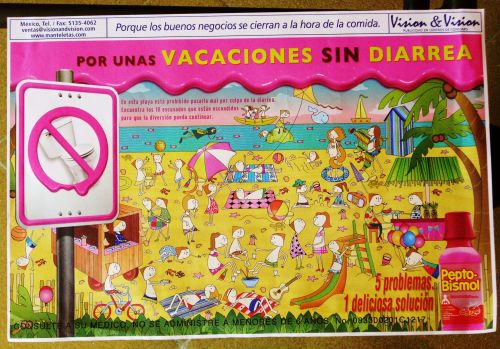
pb


This is a paper placemat used in cantinas and cafeterias at lunch hour. Usually, these placemats sport five or six small advertisements for local businesses. This one is obviously a full-page ad for Pepto Bismol. For those of you who don’t read Spanish, across the top of the sheet is the legend, “For vacations without diarrhea.” The fine print above the drawing says, “It’s prohibited to have a bad time at this beach due to diarrhea.” Perhaps appealing to the kiddies, or to those who are young at heart, within the sketch are ten hidden toilets you’re supposed to find (while waiting for your meal). Welcome to Mexico.