“Zotz” and other gems

books

On Calle Donceles in the centro histórico, there are over a dozen second-hand bookstores. Obviously most of their stock is in Spanish, but each has at least a small section of books in English (and some in French and German). They are the detritus of the dead of the last century or so; a shopper can go back in time to peruse the forgotten titles that were the bestsellers of their day: Must You Conform?, What to Wear Where, The Case of the Grinning Gorilla.

I've seen literally dozens of copies of John P. Marquand's The Late George Apley, Pearl S. Buck's The Good Earth and Vicki Baum's Grand Hotel. Even more of Be My Guest by Conrad Hilton seem to have washed ashore here. (Perhaps that is unsurprising as a copy was left in every Hilton hotel room for decades.) A 1947 novel by Walter Karig called Zotz has turned up variously on the street -- as it has at roughly half of the used bookstores I have ever been to in my life, all over the world. I've found little gems: Penguin editions of Wodehouse or Joseph Mitchell's McSorley's Old Ale House, both Butterfield 8 and Appointment in Samarra by John O'Hara, numerous Orwells and even more Graham Greenes.

I have never been a collector and am completely ignorant about the value of old books. At one Donceles store, a friend and I came upon what appeared to be a first edition of The Great Gatsby -- Scribner's, 1925, in fair shape in what may have been its original binding. It was priced at 300 pesos, about $30 US. Neither of us had much cash on hand so we let it go. I returned for it the following day when it was, needless to say, gone. A rare book dealer in New York told me that even in so-so shape that book is worth fifteen hundred bucks.
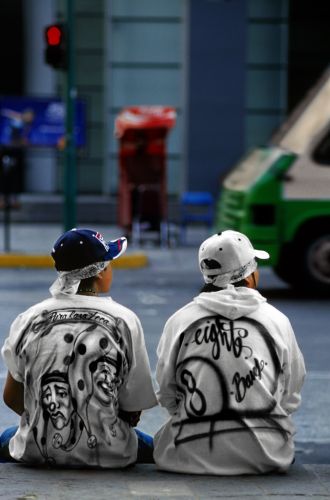
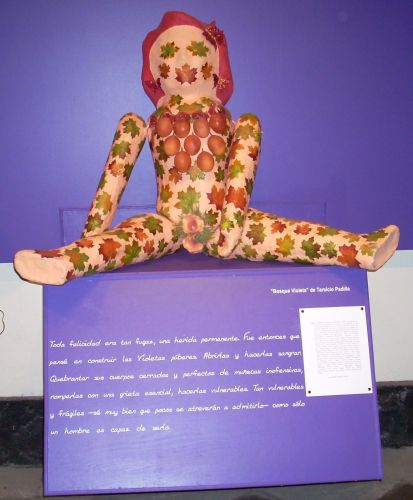
Two exhibits in the Centro Histórico

federico


My friend Federico Gama, a collage of whose Mexico City photographs is on the “about” page of this website, has a couple of pieces in an exhibition called Identidades y Fronteras en Iberoamérica (Identities and Borders in Iberoamerica), at the Centro Cultural España on Calle Guatemala #18, behind the Metropolitan Cathedral. It is an unsettling show of photographs that documents various groups of Latin Americans, who travel to other places to find a different life. (Most of them go to other countries, but one of Federico’s obsessions is photographing youths from towns and cities around Mexico who come to live in Mexico City. Two of them, whom Federico refers to as Mazahuacholoskatopunks, are pictured above.) Federico has just begun a blog, the link to which is on the list of “Friends” on the right-hand side of this page. The exhibit is up through the end of August.


Ana


Meanwhile, around the corner, at the Coordinación de Literatura de la INBA on Calle Brasil #37, is an ingenious exhibit based on the novel Las violetas son flores de deseo (Violets are Flowers of Desire) by another friend, Ana Clavel. Ana’s book is about Julián, a man who sublimates his desire for his pubescent daughter, Violeta, by creating a series of dolls inspired by his cravings for her. Ana convinced a series of artists to make sculptures based on Julián’s dream-dolls. The show is on through August 15th.

How do you say soju in Spanish?

Soju

Mexico City may not be as international as London or New York, but it gets more multi-culti all the time. I recently went to a Korean bar and restaurant called A Cu Yung, on Calle Río Panuco, almost at the corner of Río Ebro, in the Colonia Cuauhtémoc. I had brought a friend along for her birthday dinner. We were the only non-Koreans in attendance.

Menu

The waitress handed us menus in Korean, and apologized for not having any in Spanish. So we asked her what they served, and in a quite halting version of her second language, she more or less explained some of the highlights on the menu (seafood soup, fried chicken, the Korean seafood pancake known as haemool pajeon). The dishes are quite large, so if you want to try more than one thing it is best to go with three or four people.

Bob

I realize how much I have adapted to Mexico City – even though I am a gringo, I no longer think of myself as a “foreigner” around here. Yet at A Cu Yung anyone who isn’t Korean is the “gringo.” Being there felt inordinately cosmopolitan, even like a cheap trip to a foreign country. Many Koreans are heavy smokers, but recently a law was passed banning smoking in bars and restaurants in Mexico City. Above is the restaurant's shrine to smoke, complete with Mr. Marley in the act and various brands of imported cigarettes, real and chocolate.

The difference between L.A. and el D.F.

la-022.JPG

I recently passed through Los Angeles and one afternoon was driving around Hollywood with D.T., a chum from my school days. Happy hour was upon us, so we decided to repair to the Formosa Cafe, my favorite bar in the city, and one of the few that still looks more or less the same way as it did in the 1940s. (It is in fact such a museum piece that it has been used as scenery in various period films, including L.A. Confidential.)

At a certain stretch of Formosa Street, D.T. saw a sign warning that he wasn't allowed to make a right turn. There was no visible reason why not, he groused, and he didn't feel like driving around in circles, so he decided to make the turn anyway. I mentioned that this sort of logic and his subsequent unlawful action would make him not only a typical but an exemplary driver in Mexico City.

la-037.JPG

However, unlike in my home town, on Formosa Street there was a patrol car lying in wait for just the sort of miscreant who would dare to make an illegal turn. No problema: D.T., showing that he is at heart a chilango, simply stepped on the gas and tried to lose the cop in traffic. My heart leapt at the idea of getting into an actual Hollywood-style car chase in actual Hollywood.

Unfortunately the patrolman caught up to D.T. on Santa Monica Boulevard. He wrote him up a ticket for a stiff fine. D.T. will have the opportunity to take an on-line traffic course which, if he passes, will result in his getting the infraction stricken from his driving record.

la-039.JPG

Had D.T. actually been caught making an illegal turn by a Mexico City traffic cop, profuse apologizes and a 100-peso note (worth about $10 US) - "para el refresco"  (so the cop could "buy himself a soft drink") - would have been sufficient to settle the matter on the spot. Here D.T. enjoys a martini at the Formosa after the fireworks were over.

¡Ya llegó!

cover-llaves.jpg

When I came to Mexico City in 1990, with limited knowledge of Spanish, I knew that I wanted to learn to the language well, and to be able to read anything from Don Quijote to One Hundred Years of Solitude in the original. But I never dreamed I would one day write in Spanish, let alone that a prestigious publishing house like Sexto Piso would consider my work worthy of a book. But here it is. Las llaves de la ciudad is a collection of pieces I wrote about Mexico City in the last few years, published in various magazines and newspapers here. The great majority of them are portraits of people: the proprietor of the first and only boutique in the world that sells nothing but bulletproof clothing; Alín, a deaf-mute transvestite who has invented her own sign language and sells her company in a beer joint; Viviana Corcuera, who was Miss Argentina in 1964, and for close to 40 years has been Mexico City's most notorious socialite. Each of these people is a stone in what, in the book's totality, becomes a mosaic of Mexico City.

For the moment it is only available in Mexico, at most major bookstores or if you click here. It will shortly be obtainable on Amazon; please watch the books page for its progress.