Hot ice

april-12-045.JPG

The first table-dance bars opened in Mexico City in the early 1990s, a year or two before the passage of the North American Free Trade Agreement. In the intervening fifteen years, they have become a commonplace in the city. The most expensive feature curvy blondes from Eastern Europe (a common wet dream for the Mexican male) or heart-stopping beauties from South America. The cheapest variety employ women with bodies shaped like dinner rolls, who strip to the skin while pole-dancing, but never remove their long-suffering expressions.

I hadn't been to a table-dance bar in a long time, until the other night when I went to the Plaza Garibaldi with a woman friend who, after our third drink, all but insisted we go to the Déjà Vu, located across the street on the Eje Central Lázaro Cárdenas. The experience was one of those moments - which occur frequently in Mexico City - where I am caught by surprise after feeling as if I have seen everything.

As part of her act, one of the dancers in the club ingested and then discharged an ice cube, utilizing an orifice most commonly employed for other purposes. Shortly after, another dancer appeared on the runway. She was clearly, visibly pregnant, four or five months into her term.

Art attack

habita-defaced-3.JPG

At the end of last month, to coincide with FEMACO, the annual Mexico City contemporary art fair, the owners of the Hotel Hábita in the fashionable Polanco district hired 20 graffiti writers to cover the façade of the building with their work. As they were painting, police tried to intervene and stop them. This is a picture of the finished product.

diet.JPG

The Hábita was the first 21st-century hotel in Mexico City, and not only due to the fact that it opened in the year 2000. At the time it was the only hostelry with a minimalist, nearly monochromatic, white Philippe Starck-ish design to ts 36 rooms. Several imitators have opened since. Here, Rafael Micha, one of the Hábita’s owners, demonstrates that he has sold his soul to the devil. This is my guess, at any rate, given (a) his diet, and (b) that he remains slim in spite of it.

darling.JPG

This is Mari Carmen, one of the Hábita’s public-relations specialists. She is the closest approximation we have to Julie Christie in Darling in Mexico City.

Cantinflas ER

february-24-001.JPG

In the guise of a quick-witted scrapper from Mexico City’s starving class, a comic actor named Mario Moreno, known as Cantinflas, enjoyed great success throughout the Spanish-speaking world from the 1930s through the 1960s. Although Charlie Chaplin once called him “the greatest comedian in the world,” his films were practically unknown apart from Latin America and Spain. This is because of much of his humor is based on elaborate plays on words, as well an ability to speak at great length without actually saying anything. (His style of speech is so common among Mexican politicians that an adjective was coined for their discourse: cantinflesco.)

Outside of the Hospital Obregón in the Colonia Roma, there is a revolving statue of the comedian, a few yards from the emergency-room entryway. Why it has been placed there remains a mystery. Did hospital administrators think that he might cause a chuckle among the unfortunates who are about to go inside for treatment? Or that when a doctor gives a patient the bad news, it won’t seem so awful if he thinks of Cantinflas?

I never thought I’d see the day

no-smoking.JPG

Mexico City has always struck me as one of those places that welcomes the unapologetically inveterate smoker. Candy stands and newspaper kiosks sell single loose cigarettes on the street, and at 3 a.m. parties always degenerate into discussions about who knows a coke dealer that will deliver at that hour, and where is the closest convenience store to buy smokes. The anti-tobacco lobby had its place but it was condescended to, if not laughed at; I remember, for example, in a restaurant people blithely lighting up underneath a “no smoking section” sign.

Until now. Last month the City Assembly passed a law that banned tobacco from public places. Even more shocking, people are obeying without putting up a fight; even late at night, at bars and cantinas the customers go out onto the street for their tobacco fix rather than try to flout the law.

Some supposed intellectuals are making a stink about how the smoking prohibition flouts their “rights,” and a couple of journalists incurred the wrath of many when they compared the state’s sanctions against cigarettes to the Nazis and their concentration camps. While debate has been promised it looks like their arguments will quickly go up in smoke.

Brand-new Jew

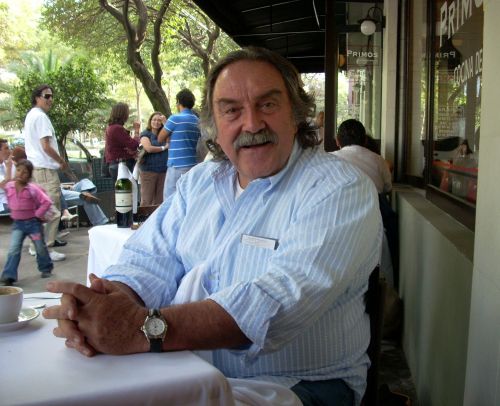
armendariz.JPG

Like his father before him, Pedro Armendariz Jr. is a beloved movie actor. Since his debut in 1966 in Fuera de la ley (Outside the Law), he has appeared in about 200 flicks, playing private eyes and police detectives, soldiers and priests, sea captains and state governors and even Pancho Villa himself. He has acted in U.S.-financed extravaganzas filmed in Mexico such as The Legend of Zorro, Once Upon a Time in America and License to Kill. Yet in recent years, he has converted to Judaism – at least on the Mexico City stage, where he appeared in back-to-back long runs as Tevye the dairyman in Fiddler on the Roof, and Max Bialystock in The Producers. Here he is on a recent afternoon, savoring a coffee after a non-kosher lunch at the restaurant Primos in the Colonia Condesa.